







Buildings across diverse climate zones are subjected to significant external forces, directly challenging their structural integrity. Structural integrity is essential for the safety, durability, and longevity of a building, and is needed throughout the building envelope. Architects and engineers need to be prepared to design buildings to withstand the impacts of different loads on buildings to secure structural integrity and performance. To determine proper structural loading for buildings to handle, the American Society of Civil Engineers (ASCE) developed ASCE 7: “Minimum Design Loads & Associated Criteria for Buildings and Other Structures,” so that designers can better understand how buildings are impacted by various loads acting upon buildings.
This article highlights ASCE 7, its significance to structurally sound building design, and how GreenGirt CMH™ and GreenGirt Steel™ continuous insulation systems, and the SMARTci® building enclosure system are engineered to resist the loads determined through ASCE 7 calculations.
ASCE 7: “Minimum Design Loads & Associated Criteria for Buildings and Other Structures”
ASCE developed ASCE 7, “Minimum Design Loads and Associated Criteria for Buildings and Other Structures,” to establish the minimum requirements for determining and calculating gravity loads (dead, live), environmental loads (wind, snow, seismic, flood, tsunami), and soil loads. ASCE 7 provides the methodology for determining different load combinations for safe structural design and optimal load combinations for specific structures, ensuring that structures can withstand different external forces that may impact their structural integrity. The International Building Code (IBC) references ASCE 7 as the standard for determining load requirements, and building systems must demonstrate adequate capacity to resist these calculated loads.
ASCE 7 guidelines are needed by engineers for calculating forces acting on a structure, to determine required strength, and ensure safety against various hazards and ensure resilient structures against different environmental, gravitational, and other types of loads acting upon the structure.
How GreenGirt & SMARTci Support ASCE 7 Compliance
Steel Reinforcement
The GreenGirt and SMARTci systems were developed to balance both structural integrity and thermal efficiency. While the composite fiberglass materials in each system combat conductivity, the strength of steel contributes to the structural ability of the system. Steel throughout GreenGirt and SMARTci keep the systems stiff and resistant to bending from external forces calculated using ASCE 7 methodologies.
Material Properties and System Capacity

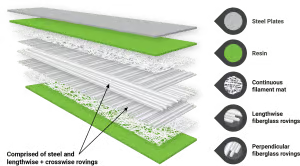
In addition to the strength of steel reinforcement, the composite fiberglass materials throughout the GreenGirt CMH and SMARTci systems are manufactured with high material strength properties in crosswise and lengthwise directions. These material properties contribute to the overall system capacity that must be validated against project-specific load demands.
The documented material strength properties of GreenGirt CMH Z-girts include:
- Crosswise Strength: 40,000 PSI
- Lengthwise Strength: 50,000 PSI
While these material properties are important indicators, what demonstrates structural adequacy is the tested capacity of the complete system, including allowable loads on clips, girts, and maximum spans, compared against the ASCE 7-calculated load demands for each specific project. Project-specific engineering calculations or ICC-ES evaluation reports provide the validation that the system capacity exceeds the required load demands.
Finite Element Analysis and Engineering Validation
Finite Element Analysis (FEA) is a numerical method used for obtaining solutions to complex engineering scenarios associated with structures, materials, and other physical phenomena. FEA divides a structure into a finite number of smaller elements to predict the behavior of an entire system under different loading conditions and constraints. This analysis helps engineers understand how a continuous insulation system will perform under the loads calculated using ASCE 7 methods.
Every A2P project undergoes engineering review where the specific live and dead loads (as determined by ASCE 7) and cladding attachment are analyzed for stress and deflection in crosswise and lengthwise directions. FEA, coupled with thermal stress analysis, thermal analysis, and hygrothermal modeling, helps determine whether GreenGirt CMH and SMARTci systems have adequate capacity to resist the project’s calculated loads prior to installation. This project-specific engineering validation ensures that the system’s tested capacities exceed the ASCE 7-determined load demands.
Conclusion
ASCE 7 provides clear methodology for calculating the loads that structures must be designed to resist, ensuring safety, durability, and longevity of buildings. The International Building Code references ASCE 7 for load determination, and building systems must demonstrate adequate capacity to resist these calculated loads through proper engineering validation.
GreenGirt and SMARTci systems are engineered with material properties and system capacities designed to resist the loads calculated through ASCE 7 methodologies. Through transparent reporting of material properties, tested system capacities, and consistent engineering validation including FEA testing, these systems demonstrate their ability to resist the various loads determined for each specific project. With properly engineered cladding support systems validated against ASCE 7-calculated loads, buildings achieve both code compliance and structural durability throughout their lifetimes.
Pull Specs, Details, & Drawings for GreenGirt & SMARTci Systems
Get all the documents you need to specify the durable GreenGirt and SMARTci systems for your next project to adhere to ASCE 7 guidelines.
Download A2P’s Technical Documents
Need support in designing a building envelope that complies with ASCE 7? Our expert engineers are available to offer technical guidance.
Related Resources:
A2P’s Durable Solutions for Walls, Roofs, & Windows
Read “Composite Metal Hybrid vs FRP Z-Girts: Structural Engineering Best Practices”
Read “The Essential Guide: Seven Building Codes & Standards for Continuous Insulation Success”
–
–
Frequently Asked Questions
What loads does ASCE 7 cover?
ASCE 7 provides the methodology for determining minimum design loads, including gravity loads (dead, live) and environmental loads (wind, snow, seismic, flood, and tsunami), and soil loads. It also defines load combinations used for safe structural design.
Does the International Building Code (IBC) require ASCE 7 for load calculations?
Yes. The International Building Code (IBC) references ASCE 7 as the standard for determining load requirements, and that building systems must demonstrate adequate capacity to resist the ASCE 7-calculated loads.
How do I know a continuous insulation cladding support system can handle ASCE 7 wind/seismic loads?
Structural adequacy is demonstrated by the tested capacity of the complete continuous insulation system (including allowable loads on clips, girts, and maximum spans) compared against the ASCE 7-calculated load demands for the project. Validation is provided through project-specific engineering calculations or ICC-ES evaluation reports. A2P projects undergo engineering review using methods like Finite Element Analysis (FEA) to confirm tested capacities exceed the project’s calculated loads.