








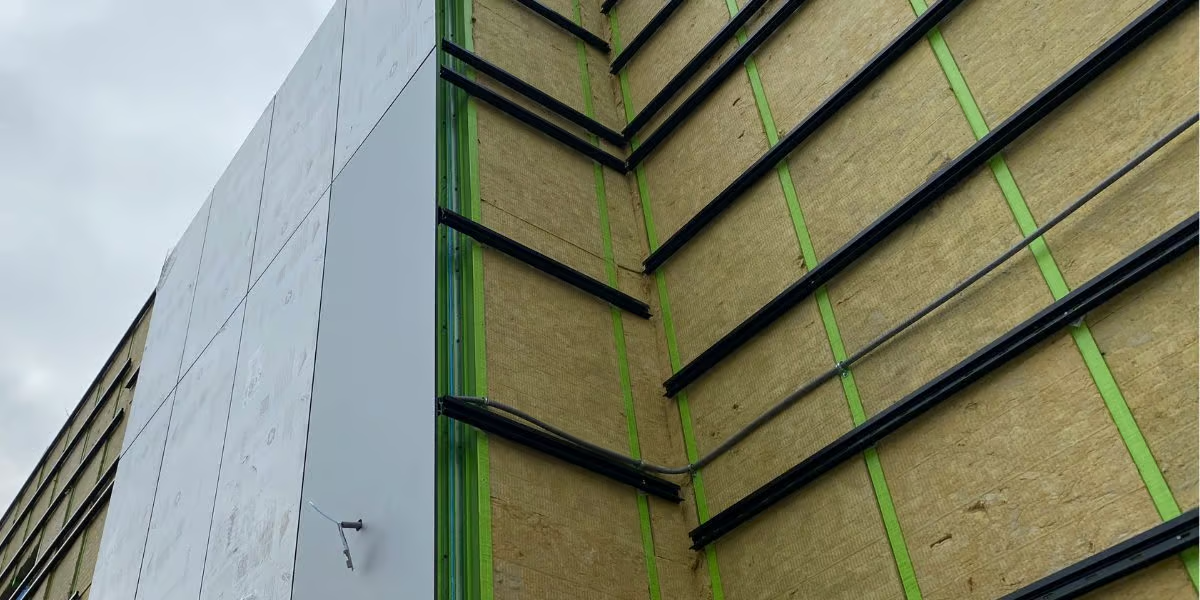
A building envelope’s real-world thermal performance hinges on the effective insulation R-value of the entire wall—not the nominal R-value printed on an insulation label. Understanding this distinction, and how different continuous insulation systems preserve (or erode) R-value, lets designers hit energy and carbon targets more confidently and cost-effectively.
R-Value
An R-value is a measure of a material’s resistance to heat flow. Higher R-values indicate greater resistance to thermal transfer, meaning that the wall has high thermal efficiency.
Thermal Bridging
Thermal bridging occurs when conductive materials (steel studs, metal Z-girts, window angles, fasteners, etc.) create a low-resistance path for heat flow, dramatically lowering effective R-values and decreasing a building envelope’s thermal performance.
Continuous insulation systems solve this problem by placing insulation outside the framing and use thermally broken attachments to minimize thermal bridging – or even eliminate it entirely. Eliminating through-metal connectors and fasteners is also critical to retaining a high percentage of the nominal insulation value and reducing thermal bridging.
Nominal R-Value
A nominal R-value is the rated thermal resistance of the insulation product alone. Manufacturers rate insulation products by assigning an R-value per inch or per panel prior to installing the insulation into the building envelope.
This number describes how much thermal resistance the insulation can theoretically provide under ideal laboratory conditions, and is typically the advertised R-value of the insulation product. It does not account for air gaps, fasteners, or framing members.
Effective R-Value
The effective R-value is the real-world thermal resistance of the whole assembly (wall, roof, or window). This value includes studs, sheathing, cladding attachments, fasteners, and air films. These values are almost always lower than nominal R-values because thermal bridging through metal components and gaps reduces performance. For proper calculation, testing or finite element analysis (FEA) is usually required.
Why R-Values Matter
Thermal bridging occurs in a building’s walls, windows, and roof, depending on the continuous insulation materials. Clips and Z-girts with integrated thermal breaks and the right continuous insulation system can help to maintain high effective R-values and eliminate thermal bridging, depending on which materials you use.
How Continuous Insulation System Materials Impact Effective R-Values
Class I: CMH
Class I composite metal hybrid systems, such as the GreenGirt CMH™ continuous insulation and SMARTci® building enclosure systems, are a combination of composite fiberglass materials with steel-reinforced flanges that balance structural integrity and thermal efficiency. CMH systems deliver 92-99% thermal efficiency, so the wall assembly retains almost all of the insulation’s nominal R-value and maintains a high effective R-value.
Class II: Perforated Thermal Metal
Class II perforated thermal metal Z-girts are metal-based systems that integrate thermal breaks to increase the system’s thermal efficiency and effective R-value. Most perforated thermal metal systems retain lower R-values than CMH systems, solidly averaging thermal efficiency percentages in the 80%s – however, the GreenGirt Steel™ continuous insulation system produces the highest thermal efficiency of any metal-based systems.
Class III: FRP
Class III fiber-reinforced polymer (FRP) continuous insulation systems are designed to maintain high static thermal efficiency levels. FRP-only Z-girts and clip systems range from 60-98% thermal efficiency, demonstrating an increase from the nominal R-values of insulating products, but don’t provide the permanent durability and structural capacity of CMH systems.
Demonstrating the Difference

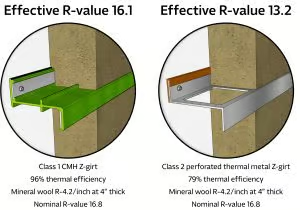
According to studies with GreenGirt CMH Z-girts and generic perforated thermal metal Z-girts, tested at 4” deep, 16” on center, and mineral wool insulation at R-4.2/in., the GreenGirt CMH Z-girt produced 96% thermal efficiency (R-value = 16.1), while the perforated thermal metal-based Z-girt only produced 79% thermal efficiency (R-value = 13.2), demonstrating a clear difference in how CMH prevails in delivering the highest quality thermal efficiency to support high effective R-values of insulating products. The 2.9-point gap in effective R-values translates to nearly 20% greater insulating power, meaning GreenGirt CMH delivers significantly higher energy efficiency than metal-based alternatives.
Conclusion
As jurisdictions tighten carbon caps and owners demand lower operating costs, walls must deliver predictable performance. CMH systems such as GreenGirt CMH and SMARTci provide a clear path: high effective R-values, robust load capacity, and proven durability in harsh climates.
The A2P engineering team offers assembly-specific thermal analyses, structural design assistance, and field support to help you:
- Quantify R-value performance before breaking ground.
- Optimize spacing, cladding, and fastener schedules.
- Document compliance for code officials and green-building certifiers.
Specify continuous insulation systems that let insulation perform as advertised and keep occupants comfortable for decades.
Get Support on Achieving a High Effective R-Value with GreenGirt & SMARTci Systems
Send us your project’s details and thermal performance requirements, and our expert engineers can assist you in designing a building envelope that will achieve the highest possible effective R-value, delivering maximum energy efficiency and eliminating thermal bridging.
Related Resources:
A2P’s Comprehensive Thermal Performance Data
–
–
Frequently Asked Questions
What’s the difference between nominal R-value and effective R-value?
Nominal R-value is the rated thermal resistance of the insulation product alone (typically the advertised R-value) under ideal conditions, and it doesn’t account for air gaps, fasteners, or framing members. Effective R-value is the real-world thermal resistance of the entire assembly (wall/roof/window), including studs, sheathing, cladding attachments, fasteners, and air films, so it’s almost always lower than nominal due to thermal bridging and gaps.
How do you calculate the effective R-value of a wall?
Effective R-value is calculated at the assembly level (including studs, sheathing, cladding attachments, fasteners, and air films), and it’s typically determined through testing or finite element analysis (FEA) rather than relying on the insulation label alone.
What can you do to maintain a high effective R-value in a continuous insulation assembly?
Continuous insulation systems help to maintain a high effective R-value by placing insulation outside the framing and using thermally broken attachments to reduce, or even eliminate, thermal bridging. It also emphasizes that eliminating through-metal connectors and fasteners is critical to retaining a high percentage of the insulation’s nominal value.