








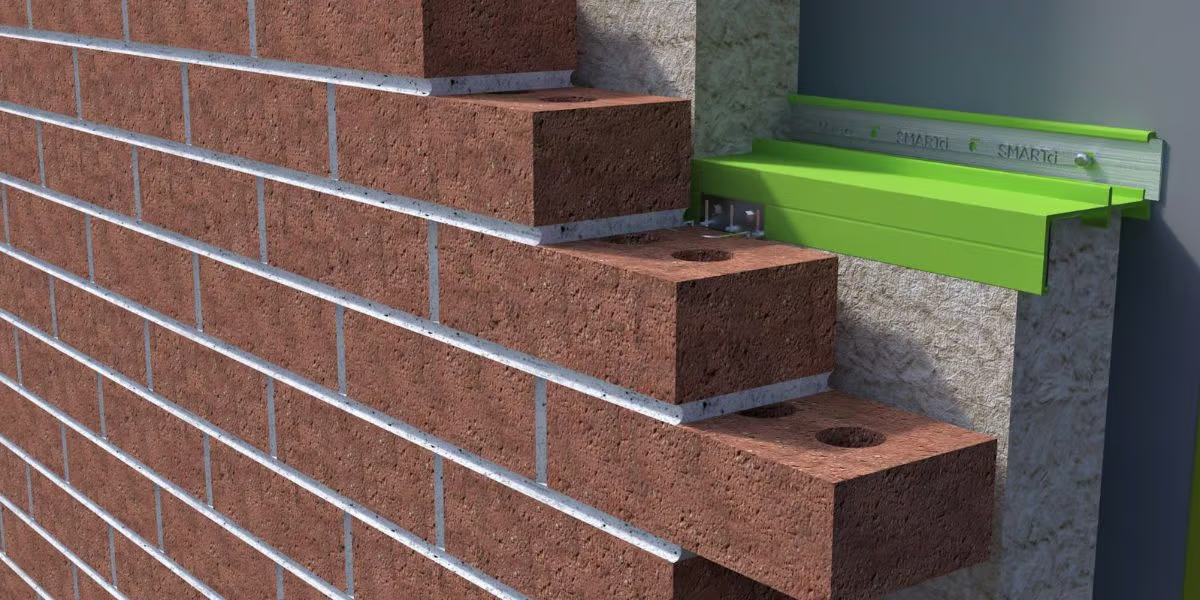
In the commercial building industry, Z-girts have been used for centuries. Applications include providing lateral support, resisting wind and dead loads, and connecting structural framing to cladding. Due to the increased concern for thermal efficiency along with advancements in technology and design, we have seen several changes to the materials used in Z-shaped girts.
In addition to traditional steel Z-girts, there are two additional types of girts. The alternate Z-shaped girt material available includes fiber-reinforced polymer (FRP) and composite metal hybrid. These three materials offer several differing structural advantages and disadvantages.
Traditional Steel Z-Girt Material
Structural steel design practices are routinely done using established uniform codes across the United States and the world. Steel materials have properties that are the same, independent of the direction considered. Some advantages of steel structural components are:
- High modulus of elasticity compared to FRP (more resistance to deflection)
- Easier and faster connection using fasteners with durable, large loads
- Better durability, torque retention, and pull-out loads when using screws compared to fastening to FRP
However, steel is not thermally efficient and can create a thermal bridge through a building envelope. Thermal bridging can cause an overall decreased efficiency, energy loss, increased energy costs, and condensation.
Generic FRP Z-Girt Material
Fiber-reinforced polymer (FRP) composite design is dependent on manufacturer recommendations. These vary tremendously as different approaches and design methods are adopted by different manufacturers. The status of FRP design practices is not favorable for advancing the successful use of FRP. This is due to variations in the design practice methods used.
FRP is significantly different from steel, as its materials are, in general, orthotropic, meaning that their engineering properties are different in each of the three space directions (x,y,z). The properties depend on the direction considered and primarily on the number of glass fibers oriented in the direction under consideration. This makes the analysis of FRP more involved.
The list of what makes FRP complex is dynamic. This is, in part, because manufacturers can customize it using different resins, fibers, fillers, color pigments, and varying their proportions. Each combination of these constituents will compose a different material with unique properties. This makes FRP highly customizable concerning its engineering properties, providing an increase in flexibility but a more difficult material to analyze structurally.
Composite Metal Hybrid Z-Girt Material
Using continuous metal inserts located in the composite fiberglass flange of the cross-linked thermoset Z-profile, the GreenGirt CMH Z-girt leverages a composite metal hybrid material selection. The GreenGirt CMH™ product maximizes the beneficial properties of both steel and composite materials. Compared to FRP, CMH increases strength and stiffness by 9.5 times, is typically at least two times better in fastener pull-out, and has greater durability and torque retention.
If you use proper fasteners, composite metal hybrid material acts as an insulator or barrier, preventing thermal energy from passing through. You can achieve this while still utilizing the advantage and structural benefits of its continuous metal inserts. The GreenGirt CMH Z-girts provide the structural benefits of both steel and composite fiberglass material. It is a best practice solution to increase the energy efficiency of a building and eliminate the possibility of thermal bridging because of the material’s unique properties, innovative design, and ease of installation.
| Feature | Benefit |
| Lighter weight* | Lower transportation costs and faster installation |
| High strength-to-weight ratio | Structural capacity |
| Higher modulus of elasticity** | Withstands greater stress |
| Improved fastener retention** | Building life product that lasts without fastener pull-through or torque loss |
| Manufacturing process* | Customizable pultrusion process does not depend on natural resource availability |
| Eliminates thermal bridging | Increased thermal efficiency and decreased energy costs |
*Compared to steel, **compared to FRP
Conclusion
The choice of Z-girt material comes down to the specific needs and requirements of your project. Steel Z-girts provide a great deal of strength and durability but do not offer the thermal efficiency benefits of FRP or GreenGirt CMH. FRP Z-girts are lightweight and corrosion-resistant but may not have the same level of strength as steel or composite metal hybrid. GreenGirt CMH Z-girts provide a good balance between strength, corrosion resistance, and thermal efficiency, making GreenGirt CMH a best-practice solution. Ultimately, the pros and cons of each material should be carefully considered.
Talk to a Building Envelope Specialist
Your local A2P sales rep can help you compare steel vs. FRP-only vs. CMH for structural performance, fastening strategy, and thermal impact.
Chat with Our Engineering Experts
Related Resources:
A2P’s Systems Comparisons Chart
A2P’s Continuous Insulation Z-Girt Classification Chart
–
–
Frequently Asked Questions
Why can steel Z-girts hurt thermal performance, even though they’re structurally strong?
Steel Z-girts are commonly used because steel has a high modulus of elasticity (good resistance to deflection) and allows fast, durable fastener connections with strong pull-out and torque retention compared to fastening into FRP. The trade-off is that steel is not thermally efficient and can create a thermal bridge through the wall assembly, contributing to decreased overall efficiency, energy loss, higher energy costs, and potential condensation.
What makes generic FRP Z-girts harder to design and specify consistently than steel?
Generic FRP Z-girts can be difficult to engineer consistently because FRP design practices often depend on manufacturer recommendations, which can vary widely. FRP is also typically orthotropic, meaning its engineering properties change by direction and depend heavily on fiber orientation and content, making structural analysis more involved. On top of that, FRP can be customized with different resins, fibers, fillers, pigments, and proportions, creating materials with different properties from one product to the next.
How does a composite metal hybrid (CMH) Z-girt compare to FRP-only Z-girts for strength and fastener performance?
A CMH Z-girt (like GreenGirt CMH) uses steel-reinforced flanges and composite fiberglass materials for optimal structural and energy performance. Compared to FRP-only Z-girts, CMH can deliver higher strength and stiffness, delivers better in fastener pull-out, and offers improved durability and torque retention. With proper fasteners, CMH is also described as acting as an insulating barrier to help prevent heat transfer, supporting higher thermal efficiency while retaining structural benefits.