







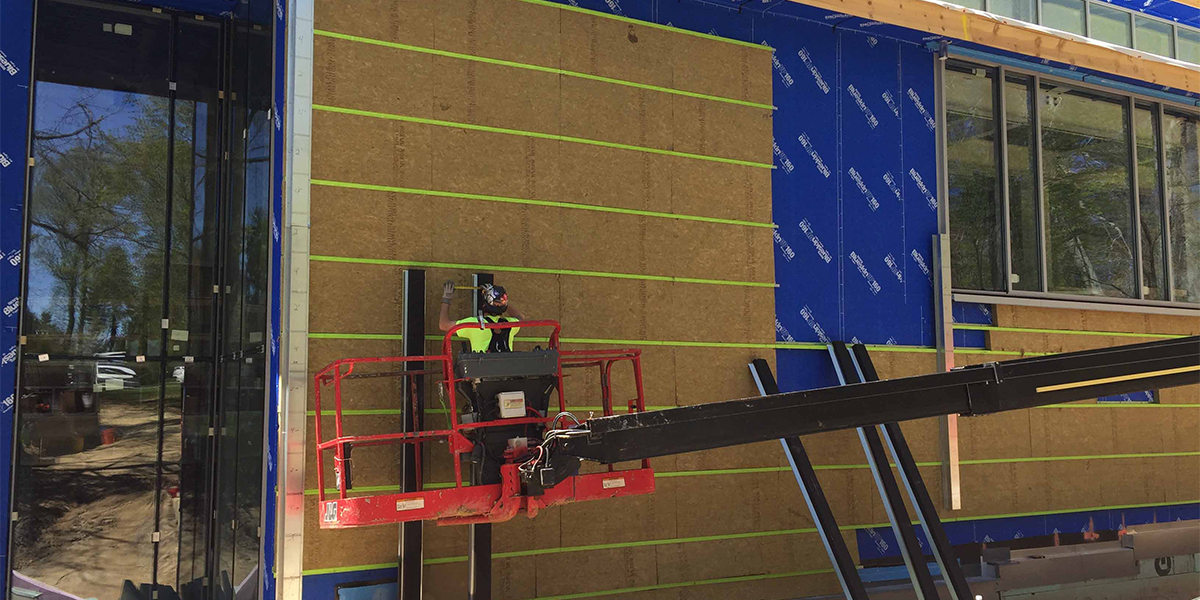
You may have heard the term continuous insulation, but what is it really? Knowing what options are on the market in a world of increasing energy prices and demands for better energy efficiency is key to a project’s success and a well-designed, long-lasting building.
When thinking about a building’s energy efficiency, insulation should be top of mind. Use this guide to confidently make decisions on the proper insulation system for your future building projects.
What types of insulation systems are available?
Designing buildings is never easy and requires building owners and designers to make many decisions with different tradeoffs. Choosing the best insulation system and energy-saving option is one of those decisions. Whether you choose no insulation, cavity insulation, or continuous insulation, each of these options comes with different upfront costs regarding materials and installation labor as well as the energy cost to operate the building in the future.
Deciding to go without insulation saves a ton of money upfront because you’re not installing anything. The downside is that the building will cost much more to operate, will be less comfortable inside, and won’t last as long as an insulated building. If the building is conditioned, insulation is critically important and likely required by local codes.
Before choosing a type of insulative material, there are two general systems of adding insulation to a structure: cavity insulation and continuous insulation. Cavity insulation is installed in the cavities of stud wall framing, in between the metal or wooden studs.
Continuous insulation is applied to the exterior of the building framing and completely encapsulates the building. Both options are economical and result in a well-insulated building, but there is a significant difference that makes continuous insulation the optimal choice.
What is continuous insulation?
Continuous insulation, an essential component to a building envelope, is a thermal layer installed on the exterior of building framing that prevents heat loss and improves the energy efficient of a building. ASHRAE 90.1 defines continuous insulation as “insulation that is continuous across all structural members without thermal bridges other than fasteners and service openings.” The ASHRAE 90.1 Standard serves as a benchmark for commercial building energy codes in the U.S. and influences many municipal building codes.
As energy codes have become more stringent, the use of continuous insulation has increased in new construction and retrofit projects for walls, windows, and roofs. The continuity of the system contributes to its effectiveness. As an uninterrupted layer, continuous insulation systems can achieve higher R-values than other insulation systems. However, to get the most out of your continuous insulation system, it is crucial to choose the right continuous insulation components and system for your specific project.
What are the components of a continuous insulation system?
A continuous insulation system has four main components: the insulation material, sub-framing, fasteners, and additional weather-resistant barrier accessories. We’ll explore each element below.
Insulation

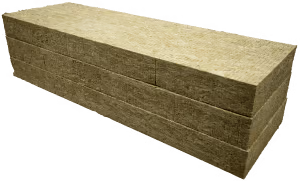
Various types of insulation material can be used within a continuous insulation system, including mineral wool and rigid insulation. Mineral wool insulation is constructed from mineral fibers, such as basalt and slag, that are heated until molten. The molten material is then spun into fibers and then formed into a mat or board. Rigid foam board insulation is made from expanded polystyrene (EPS), extruded polystyrene (XPS), or polyisocyanurate (PIR). Mineral wool and rigid foam board are available in various thicknesses and sizes and can be cut to fit any space. There are a couple of things to take into consideration when choosing your insulation material. These include:
- R-value: This is a measure of the material’s thermal resistance and is important for determining how effective the insulation will be. The higher the R-value, the better.
- Water resistance: Continuous insulation is often installed in areas that are vulnerable to moisture, so it’s important to choose a material that won’t be damaged by water.
- Fire resistance: This is an important consideration for any insulation material, but it’s especially important for continuous insulation.
Sub-Framing

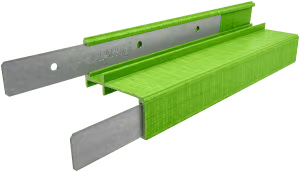
Sub-framing plays an essential role in continuous insulation systems. It helps keep the insulation material in place and is also an attachment point for exterior cladding. Sub-framing is commonly made from metal, composite, or a composite metal hybrid material. Each sub-framing material offers benefits and challenges.
Fasteners
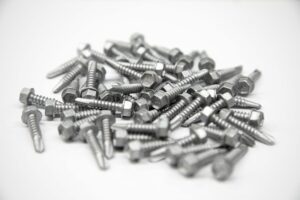
Fasteners are used to attach the continuous insulation sub-framing to the substrate. Fasteners are also used to attach exterior cladding to the continuous insulation sub-framing. Each type of fastener has its advantages and disadvantages that should be considered when selecting the best option for a particular application.
WRB Accessories

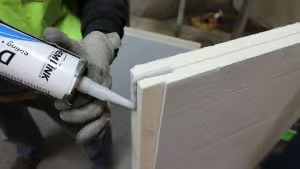
Some systems may include weather-resistant barrier (WRB) accessories such as tape, caulk, and expandable sealant offering a building enclosure solution. With the additional WRB accessories, these building enclosure systems can also serve as the weather barrier within the building envelope.
What types of insulation are commonly used with continuous insulation systems?
As with cavity insulation, many different types of insulation can be used with continuous insulation.
Polyisocyanurate (Polyiso)

Polyiso is a type of thermosetting plastic foam. Its closed cells contain a gas that has low conductivity. Insulation systems with polyiso can take the form of rigid foam boards or laminated insulation panels.
Mineral Wool

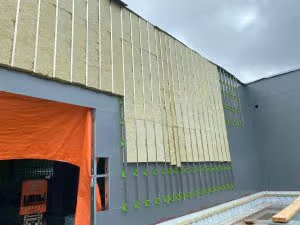
This refers to two types of insulating fibers that are man-made. One type of mineral wool is rock wool. Rock wool consists of fibers spun from minerals like basalt. Slag wool, a material commonly used in insulation systems, consists of fibers spun from waste materials that form on the surface of molten metal.
Spray Foam


Spray foam consists of polyiso and other materials. The liquid foam mixes with a foaming agent before spraying onto the building’s surface. Spray foam easily conforms to the surface upon application. However, it does require that installers have special certifications and equipment.
What are the benefits of continuous insulation?
Continuous insulation applies to the exterior framing of a building rather than between the interior studs, creating a continuous thermal barrier around the entire exterior. Continuous insulation is truly an improvement to other traditional insulation solutions. Some of the biggest benefits are:
- Elimination of thermal bridging
- Lower cost of installation
- Increased building life
- Increase in overall building health
- Built-in air, vapor and weather-resistive barrier for the building’s exterior
- Ensures building will easily hit energy standards
- Decreased risk of moisture damage
Elimination of Thermal Bridging
In the same way that a bridge gives people easy access across a waterway, thermal bridging gives heat an easy path to flow through insulation. Insulation acts as a thermal barrier to prevent heat movement, but conductive materials that interrupt the insulation can create a thermal bridge.
Thermal bridging decreases the composite R-value of the entire wall. A wall using R-20 insulation with steel studs can often end up with a composite R-value of 5 due to the thermal bridging from the studs. Best practice systems can completely eliminate thermal bridges and give the entire wall a highly effective R-value.
GreenGirt CMH sub-framing uses a composite metal hybrid material to provide a thermal break while maintaining the strength of steel. With two integrated metal fastener retention plates inserted into both flanges of the composite Z-girt, GreenGirt CMH is the strongest yet most thermally efficient best-practice solution.
Lower Installation Cost
A well-designed insulation system keeps both material and labor costs low. No building owner or contractor wants project delays, and issues seem to always cause a ripple effect. Using a GreenGirt CMH system saves time by combining many components into an easy-to-install system.
The GreenGirt CMH Z-girt inside the GreenGirt CMH continuous insulation system assembly consists of a composite metal hybrid Z-shaped girt, which enables rapid installation. The GreenGirt CMH system is typically four times faster to install than other insulation methods.
Decreased Moisture-Damage Risk
With through-metal fasteners, water vapor has the potential of condensing on the ends of the fastener. Best practice continuous insulation systems reduce the risk of any internal surface temperatures reaching the air’s dewpoint and forming moisture by eliminating the exchange of energy through thermal bridging. Combining these two features results in a better, longer-lasting structure.
GreenGirt & SMARTci Systems
When it comes to continuous insulation, the material you choose is just as important as the installation itself. This section of the wall assembly is designed to provide a thermal barrier between the interior and exterior of a building, and the wrong material can jeopardize the system’s efficacy. Our continuous insulation experts at Advanced Architectural Products are here to help you find the best continuous insulation solution to move your project forward smoothly.
A2P offers several best practice continuous insulation and building enclosure solutions, including GreenGirt CMH™, GreenGirt Steel™, and SMARTci® systems.
Chat with Our Expert Engineering Team
Selecting a continuous insulation system doesn’t have to be guesswork. Our expert engineers are available to support you in selecting the best system for your project’s needs.
Talk to A2P’s Expert Engineers
Related Resources:
GreenGirt CMH Systems Overview
Read “Expert Tips for Installing Continuous Insulation for Maximum Efficiency”
–
–
Frequently Asked Questions
What is continuous insulation?
Continuous insulation is a layer of insulation installed so it stays continuous across the wall, minimizing thermal bridges. ASHRAE 90.1 describes continuous insulation as insulation that’s continuous across structural members, with bridges limited to fasteners and service openings. It’s commonly placed on the exterior side of framing to reduce heat loss and improve energy performance.
What are the parts of a continuous insulation wall system?
A continuous insulation wall system includes (1) insulation material, (2) sub-framing, (3) fasteners, and (4) WRB accessories (and related sealing components used with the WRB). Together, these components support cladding attachment while maintaining the continuity of the thermal layer and managing water/air control details.
How much does thermal bridging reduce R-value in steel-stud walls?
Thermal bridging can dramatically reduce effective performance. For example, a wall with R-20 insulation and steel studs drops to a effective R-value of about R-5 because heat flows through the studs.