





Looking for the most effective ways to meet stringent energy code requirements while keeping up with sustainable construction trends? Thermally broken cladding support systems offer a critical intersection of energy efficiency and structural performance. These systems are designed to maintain your building’s structural integrity while mitigating energy transfer throughout the building envelope.
This article explains what a thermally broken cladding support system is, where code requirements and industry trends are headed, and how GreenGirt CMH™, GreenGirt Steel™, and SMARTci® systems are shaping the future of the market.
Definition & Details

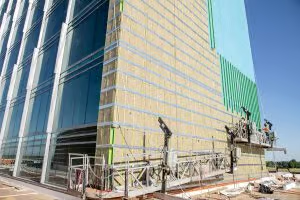
A thermally broken cladding support system is an engineered, minimally conductive framework designed to minimize heat transfer through a building’s exterior wall assembly. By interrupting thermal pathways, it effectively reduces thermal bridging and thermal bypass, which helps in maintaining high effective R-values. These systems also mitigate condensation risks, preventing moisture buildup that can compromise structural integrity, indoor air quality, and occupant comfort.
Unlike traditional metal support systems, thermally broken systems incorporate materials with low thermal conductivity that deliver both structural strength and thermal performance. They are increasingly critical in meeting strict energy codes, supporting sustainable design goals, and extending the durability of cladding assemblies across diverse climate zones.
Current Market Trend
Building codes and construction trends seek to increase sustainability and energy efficiency in new and retrofit projects. Integrating thermally broken cladding support systems with rainscreen cladding and air-gap facades can improve thermal performance and moisture management sought out by codes and trends, minimizing reliance on heating and cooling systems.
GreenGirt & SMARTci Systems: The Future of Thermally Broken Cladding Support Systems
GreenGirt CMH

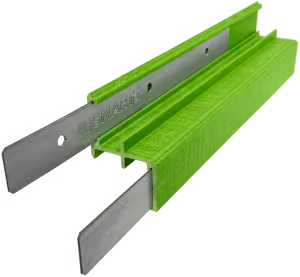
GreenGirt CMH™ is a Class I continuous insulation system that prioritizes thermal efficiency and structural integrity, without eliminating other performance requirements of continuous insulation systems. This system combines the strength of steel-reinforced flanges with the thermal efficiency of composite fiberglass materials, providing a complete thermal break along the entire building envelope.
These systems deliver the highest thermal performance, up to 99%, and retain the highest effective R-values of any continuous insulation system. ThermaLock technology eliminates the need for stick pins or through-insulation fasteners to further mitigate thermal bridging and thermal bypass.
Support your next building’s walls, windows, and roofs with the best Class I CMH systems! Visit our website to view the options we provide for GreenGirt CMH systems.
SMARTci

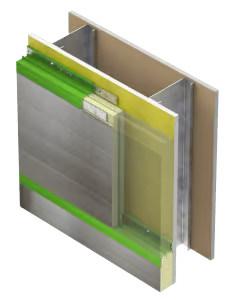
SMARTci® building enclosure systems integrate GreenGirt CMH Z-girts with custom-profiled polyiso insulation panels to achieve an air- and water-tight barrier that further increases thermal efficiency and structural integrity. This system installs in a single pass, delivering up to 98% thermal efficiency, eliminating thermal bypass and thermal bridging with reliable ThermaLock technology.
SMARTci (on closed framing) is installed over sheathing and a water-resistive barrier to create a continuous, protected envelope, while SMARTci (on open framing) installs directly over structural framing to streamline installation and reduce both time and material costs.
Visit our website to learn more about SMARTci and how it delivers optimized performance to meet the needs of every building type.
GreenGirt Steel

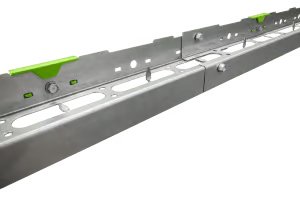
GreenGirt Steel™ is a Class II continuous insulation system engineered around its innovative thermal bracket, which delivers a true thermal break between the Z-girt and the substrate behind it. The thermal bracket dramatically reduces energy transfer and drives best-in-class static thermal efficiency. The system’s overlapping design makes installation easier, while integrated insulation retention locks on every Z-girt eliminate the need for stick pins or through-insulation fasteners—further protecting the thermal break and maximizing overall efficiency.
GreenGirt Steel Z-girts are 20-50% stronger than generic perforated thermal metal Z-girts, ensuring high-quality structural performance without minimizing the efforts to increase a building’s thermal efficiency.
Visit our website to learn more about the capabilities of GreenGirt Steel as the highest-performing Class II continuous insulation system.
Conclusion
Thermally broken cladding support systems are imperative to meet the expectations of building energy codes while setting the pace for industry trends in energy-efficient and sustainable construction. If you are looking for the best solutions to meet building codes and keep your buildings up to date on industry trends, the GreenGirt and SMARTci systems are the most effective options, paving the way for smarter building.
Get the Right Details for a True Thermal Break
Pull the specs, details/drawings, and BIM/REVIT files you need to evaluate GreenGirt and SMARTci thermally broken cladding support systems.
Download A2P’s Technical Documents
A2P’s expert engineers are available to help you design the highest-performance thermally broken cladding support system with GreenGirt and SMARTci.
Related Resources:
A2P’s Continuous Insulation Z-Girt Classification Chart
View A2P’s High-Performance Solutions for Walls, Roofs, & Windows
A2P’s Continuous Insulation Z-Girt Product Selector Tool
–
–
Frequently Asked Questions
What is a thermally broken cladding support system?
A thermally broken cladding support system is an engineered, minimally conductive framework that minimizes heat transfer through an exterior wall assembly by interrupting thermal pathways, reducing thermal bridging and thermal bypass to help maintain higher effective R-values.
How does a thermally broken cladding support system help reduce condensation risk?
By reducing thermal bridging and thermal bypass, a thermally broken cladding support system helps limit cold spots within the wall assembly, mitigating condensation risk and helping prevent moisture buildup that can negatively impact durability, indoor air quality, and occupant comfort.
How are thermally broken cladding support systems used with rainscreens and air-gap façades?
Thermally broken cladding support systems are often integrated with rainscreen cladding and air-gap façade designs to improve thermal performance and moisture management, helping projects align with evolving sustainability and energy-efficiency expectations while reducing reliance on heating and cooling systems.