








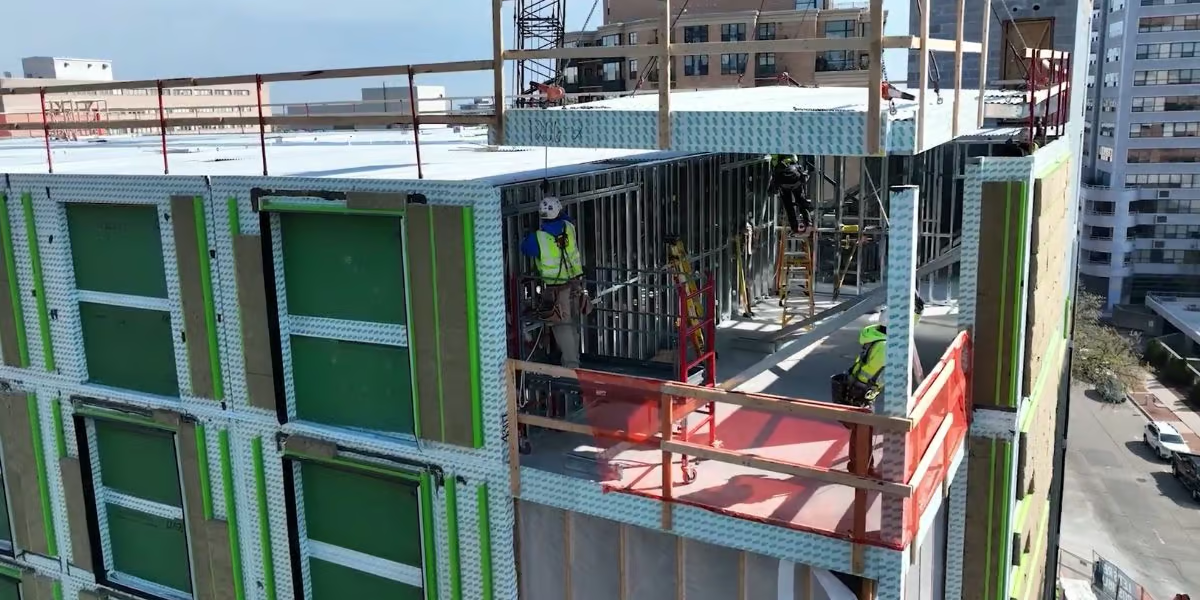
The 2021 IECC now requires continuous insulation across all building types, and that requirement applies to modular construction. For manufacturers whose workflows were built around older code, this isn’t a future consideration. It’s a current compliance problem.
The good news: solving it doesn’t have to slow the line. GreenGirt CMH™ continuous insulation and SMARTci® building enclosure systems are engineered by Advanced Architectural Products for the factory floor — factory-applicable, dimensionally consistent, and spec-ready. Modular builders using these systems are achieving full code compliance without adding field labor or disrupting production schedules. This article examines how, through real-world projects.
Modular Construction’s Relationship with Continuous Insulation
Historically, continuous insulation remained largely absent from modular building projects. Previous iterations of construction building codes did not mandate these systems, allowing contractors and manufacturers to omit them in favor of reduced production timelines and lower project costs. Beyond regulatory considerations, the industry lacked widespread awareness of the critical role continuous insulation plays in optimizing a building’s thermal performance. Many stakeholders viewed these systems as optional enhancements associated with green building initiatives and high-efficiency certifications rather than as fundamental components of sound construction practice.
This perception has shifted dramatically in recent years as energy codes have become increasingly stringent. The International Building Code (IBC) and related energy standards for buildings now require continuous insulation across all building types, including modular construction projects. These updated regulations reflect a broader recognition that continuous insulation is essential for maximizing energy efficiency and meeting contemporary performance benchmarks. While the modular construction industry has always needed to comply with energy efficiency standards established in building codes, the explicit inclusion of continuous insulation requirements has eliminated any ambiguity regarding its necessity.
The transition toward compliance has introduced practical considerations for modular manufacturers, particularly concerning the integration of continuous insulation into prefabricated panel systems. Some industry professionals have expressed concerns about perceived production complications, including the additional time required to incorporate these systems into existing manufacturing workflows. However, addressing these challenges through refined off-site construction processes is essential for modular builders seeking to deliver code-compliant, structurally sound solutions engineered to perform for the life of the building. No remediation. No callbacks. No liability carried forward.
Benefits of Using GreenGirt & SMARTci on Modular Buildings

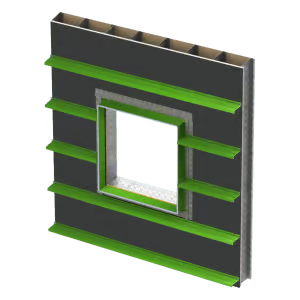
A modular wall panel unit that installed GreenGirt CMH and GreenGirt CMH XO to achieve maximized thermal efficiency, structural integrity, and ease of installation off-site prior to transportation to the jobsite.
Labor Improvements & Installation Efficiency

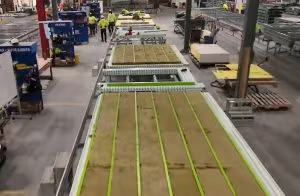
Off-site construction of wall assemblies for Embassy Suites on Judge Doyle Square in Madison, WI, which installed the GreenGirt CMH continuous insulation system before transporting to the job site.
GreenGirt CMH and SMARTci systems deliver substantial labor and cost benefits through a streamlined “stack-and-go” installation process that arrives at the jobsite ready to install in a single pass. The integrated ThermaLock technology eliminates the need for stick pins, adhesives, or additional fasteners by forming dual three-point compression seals that secure insulation in place, significantly reducing installation time while preventing material shifting or sagging. Additionally, SMARTci’s custom-profiled rigid insulation provides easier installation as the insulation fits directly with ThermaLock technology, eliminating additional retention materials to hold the insulation in place. These systems support off-site and prefabricated construction methods, accommodate every cladding material (including ACM, fiber cement, metal panels, stucco, and natural stone), and work across multiple substrates, significantly reducing on-site labor requirements and overall project costs. Same crew. Same tools. No new trade scope. Additional engineering support, shop drawings, and field backup are available through A2P upon request.
Thermal Efficiency
GreenGirt CMH and SMARTci systems achieve 92 to 99% thermal efficiency by eliminating thermal bridging: the primary cause of energy loss in building envelopes. The composite metal hybrid design combines the insulative properties of composite fiberglass materials with steel-reinforced flanges, while reliable ThermaLock technology eliminates insulation air gaps and cracks that, according to the PassiveHaus Trust, can reduce thermal efficiency by up to 50 percent with just a 10mm gap. With zero through-metal or through-insulation fasteners, these systems prevent cold spots and condensation while delivering the highest effective R-values of any continuous insulation system, directly reducing long-term heating and cooling costs.
Structural Integrity
Composite metal hybrid design maintains exceptional structural integrity without compromising thermal efficiency or installation speed as the steel-reinforced flanges deliver robust load-bearing capacity and fastener retention, guaranteeing permanent steel-to-steel connections and verifying fastener pull-out strength. GreenGirt CMH Z-girts provide equivalent loading capabilities to traditional steel Z-girts while supporting cladding systems ranging from lightweight panels to heavy natural stone, without compromising essential thermal efficiency needed for code-compliant assemblies.
Building Code Compliance
GreenGirt CMH and SMARTci systems meet International Building Code (IBC) standards and align with ASHRAE 90.1-2022 requirements – adopted in thirty-eight states – enabling modular and prefabricated projects to achieve the same thermal performance thresholds as traditionally constructed buildings. All GreenGirt CMH and SMARTci components undergo extensive testing in accordance to ASTM and NFPA 285, with easy-to-use manufacturer specifications that streamline code review and document long-term performance metrics for air- and water-resistance and R-value retention. GreenGirt CMH and SMARTci also support LEED certification, Passive House certification, and sustainable construction documentation through Environmental Product Declarations, a Declare Label, and Red List-free material chemistry.
Embassy Suites on Judge Doyle Square

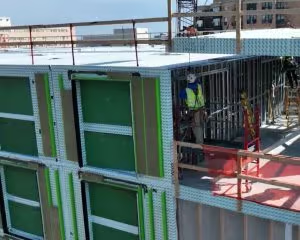
Construction of the Embassy Suites on Judge Doyle Square in Madison, WI, which installed the GreenGirt CMH continuous insulation system with panelized cold-formed metal panel walls. Photos from video by Mortenson Construction.
The Embassy Suites on Judge Doyle Square project in Madison, WI, was developed using modular construction techniques. This hotel stands nine stories high, with 262 rooms, various visitor amenities, and a prominent curved façade, serving as a hub between Capitol Square and Monona Terrace.
To maintain an efficient construction schedule without compromising the building’s performance, the GreenGirt CMH continuous insulation system was installed vertically at 3” deep and 24” on center, with mineral wool insulation and a panelized system of cold-formed metal panel walls manufactured by BLUvera. The GreenGirt CMH continuous insulation system was factory-applied to wal panels, then transported to the job site, streamlining installation and saving time in the field.
Aspirus Chippewa Falls Hospital

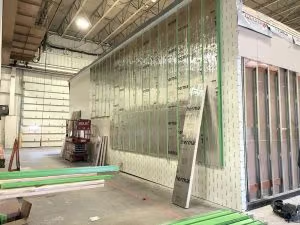
The off-site modular construction of the Aspirus Chippewa Falls Hospital in Wisconsin taking place at Bildt in Oshkosh, installing the SMARTci building enclosure system on closed framing on the unit’s walls.
Aspirus Chippewa Falls Hospital in Wisconsin is the construction of a new 35,000 square-foot hospital, utilizing modular construction methods for efficient construction processes and faster occupancy. This hospital will house emergency services, inpatient accommodations, treatment rooms, and laboratory and testing equipment, bringing accessible health care to rural areas in this region within Wisconsin.
Modular construction will keep this hospital on-track to open in September 2026 – several months sooner than if site-built practices were used exclusively, with 30% of the building using these modular methods, including off-site construction of the emergency department and clinic. Installed onto wall panels off-site in Bildt’s Oshkosh factory, the SMARTci system is installed vertically on closed framing at 3” and 5” deep and 16” on center, with polyiso insulation and fiber cement cladding. Installing the SMARTci system will not only streamline installation with its stack-and-go method, but will maintain maximum performance once applied to the building’s walls on the jobsite.
Peyton Manning Children’s Hospital at Ascension St. Vincent

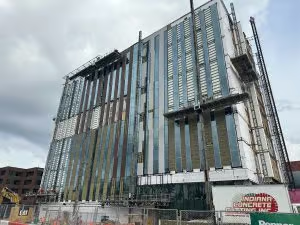
Construction of the Peyton Manning Women and Children’s Hospital project in Indianapolis, IN, which installed the GreenGirt CMH continuous insulation system on the building’s walls.
The Peyton Manning Children’s Hospital at Ascension St. Vincent in Indianapolis, IN, is the addition of a full-service tower to the existing hospital that specifically provides maternity, neonatal intensive care, pediatric intensive care, and surgical services.
As this addition utilized efficient modular construction to eliminate labor conflicts and decrease installation time, the GreenGirt CMH continuous insulation system was installed horizontally at 4” deep and 24” on center, with mineral wool insulation and Petrarch Engineered stone cladding, to ensure timely installation without sacrificing the performance quality of the building envelope. The system was installed using prefabrication and off-site efficiency, later transported to be installed on the job-site.
Conclusion
The installation of continuous insulation on modular projects is no longer a question of preference, but a matter of compliance. The modular projects mentioned throughout this article demonstrate that high-performance continuous insulation systems can be seamlessly incorporated into modular workflows without compromising the speed and cost benefits that define modular construction. These projects prove that code-compliant thermal building envelopes and efficient prefabricated construction are not mutually exclusive goals.
As energy efficiency and sustainability remain a priority for evolving building codes, modular manufacturers and builders who embrace advanced continuous insulation solutions position themselves at the forefront of the industry. GreenGirt CMH and SMARTci systems offer a clear path forward for implementing maximum thermal performance, structural integrity, and easy installation methods into off-site construction projects.
Get Pricing for GreenGirt CMH & SMARTci Systems for Your Next Modular Project
Have a modular project where its design and performance would benefit from CMH continuous insulation solutions? Your A2P territory representative can assist you in developing a quote for your project.
Related Resources:
A2P’s Comprehensive Thermal Performance Data
Download System-Specific Specs, Details, Drawings, & More
Read “Panelizers & Unitizers: Prefabrication in Modern Building”
–
–
Frequently Asked Questions
Do modular buildings need continuous insulation to meet building codes?
Yes, as energy codes have tightened, continuous insulation is now treated as a code-compliant requirement, not an optional upgrade, including for modular construction. The International Building Code (IBC) and ASHRAE 90.1-2022 are notable drivers behind this shift.
How do you install continuous insulation on modular buildings without slowing down production?
To avoid slowing down production, select continuous insulation systems designed for off-site construction. For example, GreenGirt CMH and SMARTci are designed for off-site workflows with a “stack-and-go” approach that arrives ready to install in a single pass. Green CMH and SMARTci’s integrated ThermaLock technology eliminates stick pins, adhesives, and additional fasteners, helping reduce install time while keeping insulation secured and aligned.
How much can insulation gaps reduce thermal performance in a modular wall assembly?
Even small gaps in insulation can have a major impact. According to the PassiveHaus Trust, a 10mm insulation gap can reduce thermal efficiency by up to 50%. GreenGirt CMH and SMARTci achieve 92–99% thermal efficiency by eliminating thermal bridging with ThermaLock technology and avoiding through-metal or through-insulation fasteners that contribute to cold spots and condensation risk.