








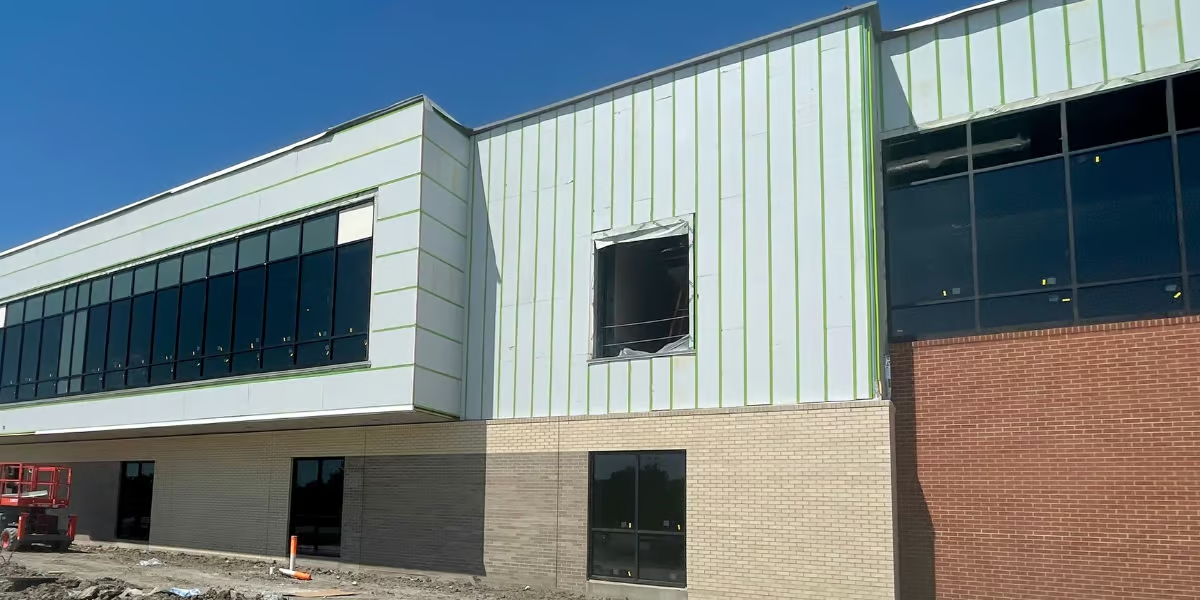
What is thermal bypass?
Thermal bypass is the unintended movement of heat around or through a building’s insulation, caused by gaps, cracks, and unintended air movement in the continuous insulation layer.
It moves heat through air, which is what separates it from thermal bridging. Most continuous insulation systems cannot eliminate thermal bypass on their own, because insulation boards leave cracks between adjacent panels, and Z-girts that use standard rigid insulation create air gaps behind the insulation that short-circuit the wall’s R-value.
The loss is easy to miss. Every gap and crack in a typical continuous insulation assembly leaks energy, and none of it shows. The wall looks finished. The modeled R-value on the drawings looks correct. The actual envelope falls behind the model, often for the entire life of the building.
The SMARTci® building enclosure system, paired with ThermaLock™ technology, is an engineered continuous insulation system that eliminates the gaps, cracks, and unintended air movement that cause thermal bypass. SMARTci is one of the building enclosure systems in the portfolio offered by Advanced Architectural Products (A2P). This article explains how it happens, what it costs the building, and what it takes to actually eliminate it on a real project.
What is the difference between thermal bypass and thermal bridging?
Thermal bridging is heat moving through a solid conductive material, such as a metal stud, a metal Z-girt, a steel shelf angle, or a fastener. Thermal bypass is heat moving through air, through gaps, cracks, and unintended air movement in the insulation.
A thermal break solves a thermal bridge. Only a continuous, airtight, mechanically locked insulation layer solves thermal bypass. They are two different failure modes with two different fixes, which is exactly why specifiers confuse them.
A thermally broken system can reduce a bridge. To stop thermal bypass, the insulation itself has to be continuous, with no gaps or cracks for air to travel through. The SMARTci system, working with its ThermaLock detail, is designed to address both failure modes in the same assembly. For the thermal bridging side of the problem, thermal bridging vs thermal bypass.
| Thermal bridging | Thermal bypass | |
|---|---|---|
| What moves the heat | A solid conductive material | Air |
| Typical example | A metal stud, a metal Z-girt, a steel shelf angle, a fastener | A crack between insulation boards, a gap behind insulation boards |
| What you need to fix it | A thermal break in the conductive path | An airtight, continuous, mechanically locked thermal layer |
| What it costs you | Localized heat loss at the bridge | Whole-assembly R-value loss across the wall |
What causes thermal bypass in a building envelope?
Two failure modes cause thermal bypass, and they almost always show up together: cracks between insulation boards, and gaps behind the insulation created by traditional Z-girts or hat channels.
Each one bleeds energy. Together they pull as-built envelope performance below the modeled R-value, often for the life of the building.
Cracks between insulation boards
Wherever two panels meet, the crack between them is an opening. Air finds it, moves through it, and carries heat along. The wider the crack, the bigger the loss. Even tightly butted boards leave a measurable gap once thermal expansion, settling, and field tolerances are accounted for.
Gaps behind the insulation
Some Z-girts hold the insulation off the substrate, leaving a gap between the insulation and the structure. That gap becomes a convective loop. Air rises behind the insulation, cools, drops, and repeats, so the effective R-value in the field falls below the rated value on paper.
Each cause carries a cost. Gaps and cracks bleed conditioned air, so the building works harder to stay comfortable. Together, they are why a 30-year-old commercial envelope can show energy bills that look decades older than it is. For a full walk-through with field photos, see gaps, cracks, and unintended air movement in building enclosures.
How is SMARTci tested and validated against thermal bypass?
SMARTci® is validated by two ASTM tests that speak directly to thermal bypass, because both measure whether the assembly has the gaps, cracks, and unintended air movement that cause it. ASTM E283 measures air leakage, confirming air is not bypassing the insulation. ASTM E331 measures water penetration through the same assembly. SMARTci passes both. A third-party DrJ Engineering Report reviews the full record.
Air leakage
Measures how much air leaks through the assembly under a specified pressure differential. This is the test that confirms air is not bypassing the insulation once the wall is built. Air leakage and thermal bypass share one cause: gaps and cracks in the assembly.
Water penetration
Measures whether water gets through the assembly under a static pressure difference. It bears on thermal bypass because water uses the same gaps and cracks air does, so a clean E331 result reinforces the air-tightness E283 measures.
Both the air-leakage and water-penetration results are documented, and reviewed by the third-party DrJ Engineering Report on the SMARTci Exterior Wall Continuous Insulation System, in the 4 essential ASTM tests that validate GreenGirt CMH and SMARTci systems.
How do you eliminate thermal bypass?
To eliminate thermal bypass, specify a continuous, mechanically locked insulation layer with no through-insulation fasteners, close off the air gaps behind the insulation, carry the layer continuously through every transition, validate the whole assembly with ASTM air-leakage and water-penetration testing, and specify a system rather than a stack of separate parts.
- Specify a continuous, mechanically locked insulation layer. No cracks between panels, and no fasteners driven through the board. The lock has to be physical, not adhesive alone.
- Close off the gaps behind the insulation. Use a sub-framing approach that holds the insulation tight to the substrate instead of floating it off the surface. A floated layer is a convective loop waiting to form.
- Carry the insulation through every transition. Wall to roof, wall to window, wall to foundation. Do not let the layer stop at a junction unless an engineered detail picks it back up.
- Validate the assembly with ASTM testing. E283 confirms the wall is airtight and E331 confirms it sheds water, the two results that show there are no gaps or cracks for air to bypass the insulation. Put the test record in the project documents, not just the rated material.
- Specify a system, not a pile of parts. One system has one party accountable for how the finished wall performs. A stack of separate components has none.
What makes SMARTci the only system that guarantees thermal bypass elimination?
SMARTci® is the only continuous insulation building enclosure system engineered to guarantee the elimination of thermal bypass.
ThermaLock™ is a built-in, dual three-point compression seal detailed on every GreenGirt CMH™ Z-girt that mates with matching custom-profiled insulation panels, locking each panel mechanically to the next. The result is a continuous insulation surface with no gaps or cracks for air to pass through. The gap that air uses to bypass conventional insulation is closed before the cladding goes on.

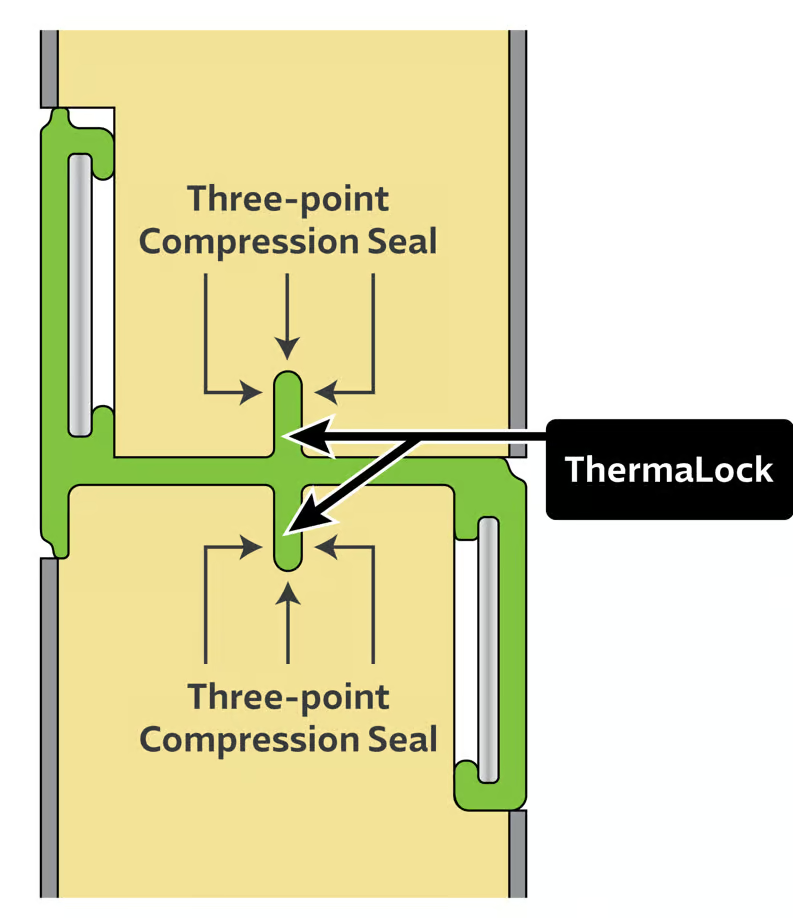
What ThermaLock™ does mechanically
ThermaLock is a feature of the GreenGirt CMH sub-framing element, not of the insulation panel. Every GreenGirt CMH forms a dual three-point compression seal. The custom-profiled insulation panel has a matching profile that mates with the GreenGirt CMH Z-girt. When the panel slides into place, the custom-profiled insulation compresses against each ThermaLock profile at three points, locking the panel to the Z-girt and closing the air pathway. There is no separate clip, no field-applied adhesive, and no through-insulation fastener required to make the lock.
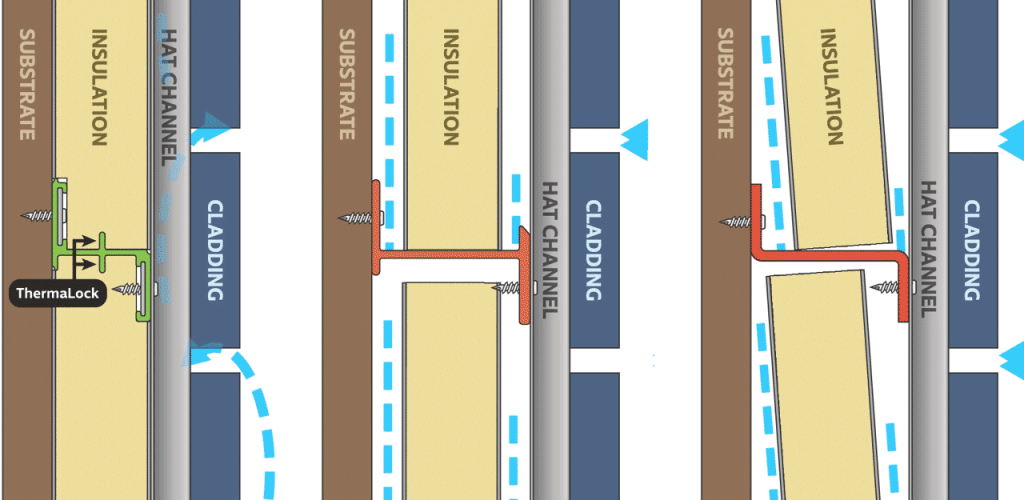
Why “guarantee” is defensible
ASTM E283 and E331 document SMARTci’s performance against air leakage and water penetration, the two results that show there are no gaps or cracks for air to bypass the insulation. The DrJ Engineering Report on the SMARTci Exterior Wall Continuous Insulation System
is the named third-party engineering review of that record. The ThermaLock detail is the specific physical mechanism that closes the gaps and cracks. Together they support the warrantable claim that thermal bypass is eliminated when SMARTci is installed correctly.
What “only” means
A system, not a product. SMARTci is the only building enclosure system that combines four things in one warrantable assembly: continuous insulation across the wall, a three-point compression seal on every GreenGirt®, sub-framing that avoids through-insulation fastening, and ASTM air-leakage and water-penetration testing with a third-party engineering review. No competitor system meets all four today. See the ThermaLock™ technology page for the mechanism in detail.
Installation caveat
As with any building enclosure, the elimination of thermal bypass depends on installation per A2P’s published guides. The system is engineered to deliver the outcome; the field execution still has to follow the detail. SMARTci is delivered with installation guides and direct engineering support so a project condition that needs a custom detail can be resolved before it becomes a leak.
How does SMARTci compare to other continuous insulation approaches?
SMARTci® closes the gaps and cracks with dual three-point compression seals on every GreenGirt CMH™ Z-girt, eliminates the gaps behind the insulation with structural sub-framing and custom-profiled rigid board insulation, and avoids through-insulation fasteners.
Standard rigid board systems with hat channels, FRP Z-girt systems, and smooth-profile insulation systems without ThermaLock each leave at least one of those pathways open. SMARTci is validated by ASTM air-leakage and water-penetration testing with a third-party engineering report on file.
| Approach to continuous insulation | Cracks between panels eliminated | Gaps behind insulation eliminated | Through-insulation fasteners | Assembly performance validation |
|---|---|---|---|---|
| Standard rigid board continuous insulation with hat channel | No, panel cracks remain | No, gap behind insulation | Yes | Limited, typically material-only |
| FRP Z-girt continuous insulation system | No, cracks between panels | No, gap behind insulation | Limited | Limited |
| SMARTci® with ThermaLock™ | Yes, pressure seals close the cracks between panels | Yes, no gap behind insulation | No, structural sub-framing avoids them | E283 air-leakage and E331 water-penetration tested; DrJ report on file |
To dig deeper into specific comparisons, see comparing continuous insulation systems, polyiso vs XPS rigid board insulation, and mineral wool with GreenGirt CMH.
The DrJ Engineering Report on the SMARTci Exterior Wall Continuous Insulation System is an independent engineering report specifiers can cite alongside the ASTM air-leakage and water-penetration results when writing SMARTci into a project document.
How does thermal bypass affect energy codes and green building standards?
Thermal bypass widens the gap between a wall’s modeled R-value and its as-built performance, which puts energy-code compliance at risk.
ASHRAE 90.1-2022 and the 2021 IECC require continuous insulation and air-barrier performance. LEED v5, Passive House, and PHIUS reward measured air-tightness. An assembly-validated continuous insulation system documents the performance each standard asks for, so the wall on paper matches the wall in the field.
ASHRAE 90.1-2022
The standard requires continuous insulation across most commercial wall assemblies in most climate zones, and it sets an air-barrier-assembly leakage limit of 0.04 cfm/ft² at 75 Pa. SMARTci’s ASTM E283 air-leakage result documents its air performance. See ASHRAE 90.1-2022.
2021 IECC
The 2021 IECC tightened continuous insulation requirements across building types. A wall that meets the modeled R-value but loses performance to gaps, cracks, and unintended air movement can fall short even when the rated material is correct. The ThermaLock detail is what makes the modeled R-value match the as-built R-value. See seven building codes for continuous insulation.
LEED v5
The Energy and Atmosphere category rewards measured envelope performance, which an assembly-validated continuous insulation system supports. See using GreenGirt CMH and SMARTci to hit aggressive LEED v5 energy thresholds.
Passive House and PHIUS
These programs judge the whole envelope, not a single metric. They reward high effective R-value, thermal-bridge-free detailing, airtightness, and moisture control working together, because all four feed the energy model a project is certified against. SMARTci® contributes on every front: continuous insulation that holds its rated R-value across the wall, sub-framing that avoids the thermal bridges that erode it, ThermaLock™ that closes the unintended air movement measured by ASTM E283, and an assembly that manages moisture as it controls air. That combination is what a Passive House or PHIUS target depends on. See Passive House with GreenGirt CMH and SMARTci and PHIUS technical guidance for high-performance envelopes.
Where has SMARTci eliminated thermal bypass on real projects?
SMARTci® is installed on verified projects across building types and states—from a 177,000-square-foot hospitality envelope to a public K-12 school and a state law-enforcement academy.

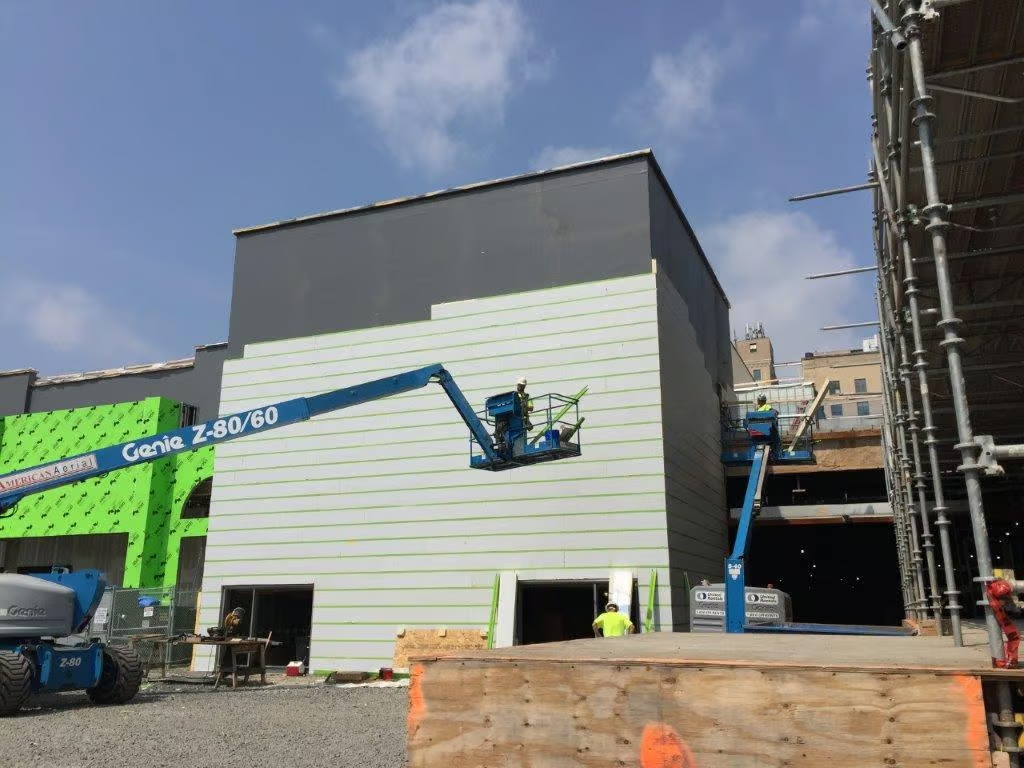
Springfield, MA • Hospitality / Recreation
MGM Springfield
Why it matters: seven cladding types on a single 177,000-square-foot envelope mean seven sets of transitions and penetrations, and every one of them is a place where gaps, cracks, and unintended air movement can start. SMARTci held the assembly tight across all of them. If you are specifying a mixed-cladding wall at this scale, this is the project that shows the system holds up.
| Architect | Friedmutter Group |
|---|---|
| General Contractor | Tishman Construction Corporation |
| Installer | H. Carr & Sons Co. |
| Systems specified | SMARTci® Building Enclosure System |
| Project size | 177,000 SF |


Jefferson Hills, PA • K-12 education
Thomas Jefferson High School
Why it matters:a school envelope carries a lot at once. Energy-code compliance, healthy indoor air, and a tight operating budget all ride on whether the wall actually stops air leakage. A 60,000-square-foot SMARTci envelope on a public high school shows the system fits a K-12 budget and still delivers the air-tightness this article describes.
| Architect | WTW Architects |
|---|---|
| General Contractor | Nello Construction |
| Installer | Franco Associates |
| Systems specified | SMARTci® Building Enclosure System |
| Project size | 60,000 SF |

Plainfield, IN • Public works
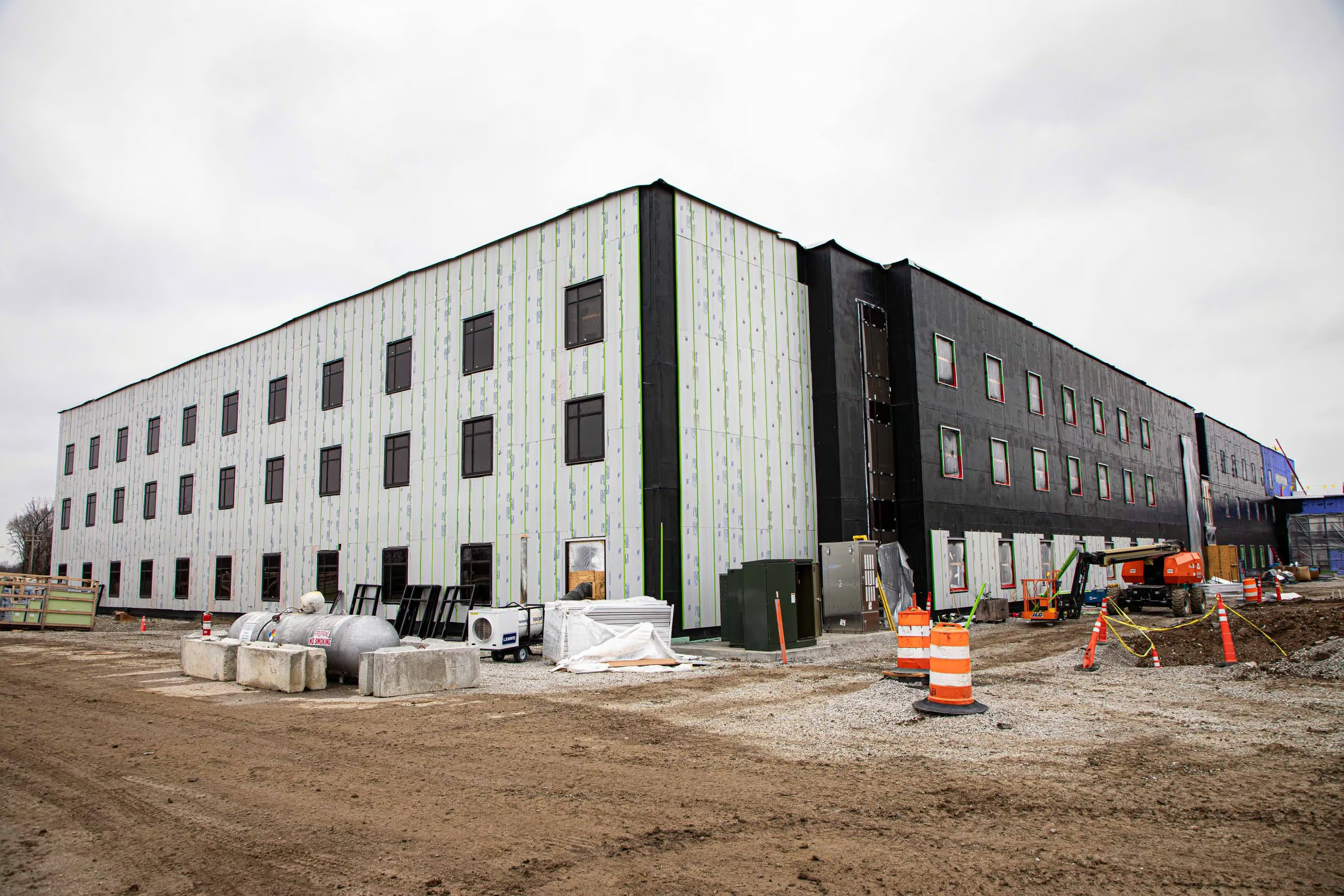
Indiana Law Enforcement Academy
Why it matters: two A2P systems on the same building. SMARTci® on the walls eliminates thermal bypass, and GreenGirt XO™ at the openings handles thermal performance at the windows. That is the advantage of a portfolio. You can match a different system to each envelope condition instead of asking one product to do everything it was never designed to do.
| Architect | CSO Architects |
|---|---|
| General Contractor | Shiel Sexton / Powers & Sons |
| Installer | Engineered Facades |
| Systems specified | SMARTci® Building Enclosure System + GreenGirt XO™ for windows |
| Project size | 52,000 SF SMARTci + 12,000 SF GreenGirt CMH XO |
Frequently Asked Questions
What is thermal bypass?
Thermal bypass is the unintended movement of heat around or through a building’s insulation, caused by gaps, cracks, and unintended air movement in the continuous insulation layer. It moves heat through air, which is what makes it different from thermal bridging. Most continuous insulation systems cannot eliminate it on their own. SMARTci® with ThermaLock™ is engineered to do so. See how SMARTci eliminates thermal bypass.
What is the difference between thermal bypass and thermal bridging?
Thermal bridging is heat moving through a solid conductive material, like a metal stud or a steel fastener. Thermal bypass is heat moving through air and through gaps and cracks in the insulation. The fix for thermal bridging is a thermal break in the conductive path. The fix for thermal bypass is a continuous, mechanically locked thermal layer. Read the full thermal bridging explainer.
What causes thermal bypass in a building envelope?
Two failure modes, almost always together: cracks between insulation boards and gaps behind the insulation created by traditional Z-girts or hat channels. Each one bleeds energy. Together they drag as-built envelope performance below the modeled R-value, often for the life of the building. See the gaps, cracks, and air channels deep-dive.
How do you eliminate thermal bypass?
Specify a continuous, mechanically locked insulation layer with no through-insulation fasteners. Close off the gaps behind the insulation. Carry the layer continuously through transitions. Validate with ASTM air-leakage and water-penetration testing. Use a system, not a stack of components. SMARTci® is engineered to deliver all five. Talk to A2P engineering about your project.
What is ASTM E283 and why does it matter for thermal bypass?
ASTM E283 is the standard test for air infiltration through an exterior wall assembly under a specified pressure differential. It is the test that confirms air is not bypassing the insulation in the field. SMARTci passes ASTM E283, and the companion ASTM E331 water-penetration test. Read the Proven Performance ASTM article.
What is ThermaLock™, and how does it eliminate thermal bypass?
ThermaLock™ is a built-in, dual three-point compression seal detailed on every GreenGirt CMH™ Z-girt that mates with the matching custom-profiled insulation panel, locking each panel mechanically to the Z-girt. The result is a continuous insulation surface with no through-seam pathway. The gaps and cracks that air uses to bypass conventional insulation are closed before the cladding goes on. See the ThermaLock technology page.
Is SMARTci® really the only system that guarantees elimination of thermal bypass?
Yes. SMARTci® is the only building enclosure system that combines, in one warrantable assembly: continuous insulation across the wall, dual three-point compression seals on every GreenGirt CMH™ Z-girt that close the gaps and cracks, sub-framing that avoids through-insulation fastening, and ASTM air-leakage and water-penetration validation with a named third-party engineering report. No competitor system satisfies all four conditions today. See the SMARTci system overview.
How does thermal bypass affect ASHRAE 90.1 and energy code compliance?
ASHRAE 90.1 sets continuous insulation requirements and air-barrier thresholds. A wall that meets the modeled R-value but loses performance to gaps, cracks, and unintended air movement can fall short of compliance even when the rated material is correct. SMARTci’s ASTM E283 air-leakage result is the proof record specifiers use to document compliance. Read the ASHRAE 90.1-2022 guide.
Can thermal bypass be tested in the field, or only in a lab?
Both. ASTM E283 is the lab test that validates the assembly under controlled conditions. Field testing, including blower-door testing on a completed building, can confirm the assembly performs as expected once installed. SMARTci’s lab-tested record gives field testers a baseline to compare the as-built envelope against. Learn more about thermal testing.
How does thermal bypass connect to thermal bridging at windows?
Thermal bypass on the walls and thermal performance at the window openings are two ways a continuous insulation or building enclosure system can lose performance. SMARTci® addresses thermal bypass on the walls. GreenGirt XO™ addresses thermal performance at the window openings. Used together on the same envelope, they close both. Read the thermal window framing article.
Does eliminating thermal bypass help with LEED, Passive House, or PHIUS?
Yes. Each rating system rewards measured envelope performance. LEED v5 Energy and Atmosphere credits, Passive House airtightness targets, and PHIUS air-leakage thresholds all benefit from an assembly-validated continuous insulation system. SMARTci is documented for each. See SMARTci with LEED v5.
How does SMARTci® work with polyiso, EPS, or XPS insulation?
SMARTci is engineered to work with multiple insulation types. ThermaLock’s dual three-point compression seal mates with custom-profiled polyiso, EPS, or XPS, as shown in the engineering diagram for this article. XPS is documented on the Indiana Law Enforcement Academy project above. See the introduction to insulation materials.
Specify with A2P
Eliminating thermal bypass is a system decision, not a product decision. SMARTci® is engineered to deliver the outcome, ThermaLock™ is the mechanism that makes the seal work, and A2P’s engineering support is how a specification becomes a built envelope that performs as drawn.
- Compare SMARTci on closed framing vs SMARTci on open framing to match the system to your project’s framing condition.
- Talk to engineering about your project’s air-leakage and energy targets.
SMARTci® is part of Advanced Architectural Products’ portfolio of building enclosure systems, alongside GreenGirt CMH™, GreenGirt Steel™, and GreenGirt XO™ for window openings.