







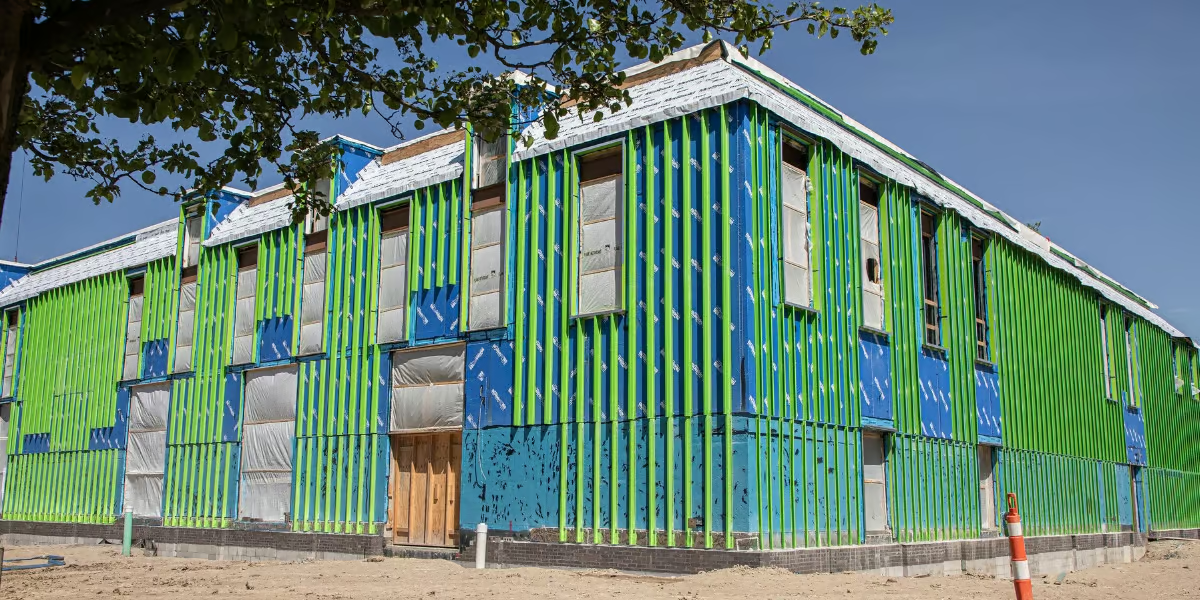
What Is Structural Thermal Window Framing?
Structural thermal window framing is a building envelope system that carries continuous insulation through the head, jamb, and sill of a window or door opening, bringing the window into alignment with the wall’s continuous insulation so the envelope performs as a single continuous assembly.
In plain language: it’s the framing that keeps your wall’s insulation working at every window, instead of letting heat sneak around it through the metal frame.
You’ll also see it called a structural thermal framing system for windows. The longer name matters because the framing has two jobs at once. It insulates the opening, and it carries the structural load of the window, the cladding, and every fastener at the perimeter.
That’s the gap GreenGirt XO™ is built to close. It’s part of Advanced Architectural Products’ portfolio of building envelope systems. GreenGirt XO is made of a composite metal hybrid material that combines thermal break performance with steel-grade structural capacity in one piece. One component, both jobs, same opening.
If you’ve been doing this work for a while, you may know this gap by another name. Some teams call it the wall-to-window thermal bridge. Some call it window flanking. Whatever it’s called on your drawing set, it’s the same problem, and it’s solvable.
Why Wall Continuous Insulation Fails at the Window
Heat takes the path of least resistance. In most commercial walls, that path runs straight through the metal frame around every window.
Picture a wall insulated to R-30. Now picture the head, jamb, and sill of every window in that wall. Those are typically metal, with far less resistance to heat. The mismatch creates a continuous bridge from inside to outside at every opening, and that same R-30 wall has an effective performance of about half of what is expected.
This is what we call thermal flanking. Even when the wall continuous insulation is detailed correctly, heat just detours around it through the opening. If your energy model doesn’t account for that effect, the model overstates performance. Sometimes by a lot.
More wall insulation won’t help. The bridge isn’t in the wall. It’s at the opening. The only fix that actually works is a framing system that carries continuous insulation across the head, jamb, and sill.
When this gets missed, the cost shows up in three places:
- Energy bills run higher than the model predicted. Often for the life of the building.
- LEED and other certifications get challenged when reviewers ask how the model handles window framing.
- In bad cases, condensation forms at the cold metal edges of the opening. That can lead to mold and durability issues that show up years after closeout.
None of that is visible at substantial completion. It surfaces only after the building is in use.
For a closer look at how this failure mode appears on the drawing set, see thermal flanking at windows.


How Thermal Window Framing Works
A structural thermal framing system for windows does five things at once. All five have to be true, or the assembly won’t deliver what the spec promises.
- The framing runs continuously through the head, jamb, and sill of the rough opening, aligning the thermal plane of the window with the thermal plane of the wall continuous insulation. The insulation plane stays unbroken from one side of the wall to the other.
- The framing is thermally broken. It doesn’t act as a metal bridge between the interior and the exterior. This window framing thermal break is what kills the flanking path.
- The framing is structural. It carries dead loads, live loads, and/or lateral forces that accumulate at connections and openings. Not just an insulator.
- The framing matches the wall’s continuous insulation depth. The assembly stays flush with the rest of the continuous insulation plane, and the cladding lays cleanly across the transition.
- The framing works with the wall substrate, whether that’s CMU, stud, or precast. One system across the project’s wall types, not three.
When all five are true, the wall and the window framing operate as one continuous thermal plane. For a deeper look at how thermal framing for windows performs in real assemblies, see the related article. For window-specific options across A2P’s portfolio, see window continuous insulation solutions.
What the Psi Value Tells You
Psi value, also written ψ value, is the linear thermal transmittance at a junction in the building envelope. It’s measured in BTU/(hr·ft·°F) or W/(m·K). It tells you how much heat passes through one foot of a junction for every degree of temperature difference. Lower is better.
GreenGirt XO™ achieves a linear thermal transmittance (Psi, ψ) value of 0.025 BTU/(hr·ft·°F) [0.043 W/(m·K)] at sill, head, and jamb perimeter conditions, third-party verified per ISO 10211 by RDH Building Science. Based on basis-of-design simulation of steel-stud framing, exterior continuous insulation, and aluminum framed-fenestration.
Here’s why that number matters. An unbroken metal head or jamb in a typical commercial wall can carry an order of magnitude more heat per linear foot than a thermally broken one. If you’re modeling to ASHRAE 90.1, IECC, or Passive House, the gap between a high-performance framing Psi value and a legacy one shows up directly in the energy model.
Worth noting: most wall sections we see don’t list an opening Psi value at all. That isn’t because it doesn’t exist on the project. It’s because the framing wasn’t selected with the value in mind. Once it’s in the field, that gap is hard to close.
The ISO 10211 reference matters too. ISO 10211 is the international standard for calculating thermal bridges, and it’s the basis Passive House and most high-performance reviewers use. When a Psi value is reported per ISO 10211 and verified by a named third party, that’s the format energy modelers expect to see.
Thermal Window Framing vs. Other Approaches: A Side-by-Side Comparison
Here are the four most common ways teams detail a window opening, and what each one actually does to the envelope.
| Approach at the window opening | Continuous insulation through opening | Structural capacity | Thermal performance behavior |
|---|---|---|---|
| Standard wall continuous insulation, no window framing | No, stops at opening | Not applicable | Poor thermal performance |
| FRP-only thermal break clip at opening | Partial | Limited under cladding load | Better than no break, capacity-limited |
| Unbroken metal head and jamb | No | High structural capacity | Severe thermal flanking |
| GreenGirt XO system | Yes, through head, jamb, and sill | Steel-grade structural capacity | Psi value of 0.025 BTU/(hr·ft·°F) per ISO 10211 |
The first three approaches each fail at least one of the three jobs the opening has to do. Only an integrated structural thermal framing system delivers all three at once.
If you’re reviewing a manufacturer’s spec, here’s what to look for.
- A published Psi value with a named third party behind it
- Structural load tables that match your specified window units
- Detail packages that show the head, jamb, and sill connections, including the shadow lines for high-performance windows at the cladding interface
- A depth range that fits your wall’s continuous insulation, not just one or two sizes
What does that mean in practice? For the energy modeler, the gap between a high-performance framing Psi value and a legacy one changes the building’s effective wall R-value, even when the wall field insulation is identical. For the architect, it changes whether the as-built envelope earns the certification credits the project was designed for.
2024 Best of Products Award
GreenGirt XO won the 2024 Best of Products Award from Architect’s Newspaper, recognized specifically for closing the wall-to-window thermal gap. See Architect’s Newspaper Best of Products 2024.
How To Specify Thermal Window Framing
This is the pattern that works on most commercial projects. It’s aimed at architects, specifiers, and building envelope consultants writing or reviewing the wall section.
- Identify every opening type on the project. Punched windows, ribbon windows, curtain-wall transitions, and door openings all behave differently. They may need different framing dimensions.
- Match the framing depth to the wall’s continuous insulation depth. GreenGirt XO is available in half-inch increments from 2 to 6.5 inches to match common continuous insulation assemblies.
- Confirm the framing carries the structural load. Pull the manufacturer’s load tables and check them against your specified window units and cladding system.
- Pull the Psi value from the manufacturer’s ISO 10211 documentation. Make sure it meets your energy model and any code or certification target. Ask for third-party verification, not just the headline number.
- Coordinate the framing detail with the wall continuous insulation, the air barrier, and the water-resistive barrier. All three planes need to stay continuous across the head, jamb, and sill, not just the insulation plane.
- Specify the manufacturer’s installation guide and detail package by section and document number. Give the GC and installer one approved reference to build from.
For a quick-reference checklist that supports this workflow, see the energy-efficient windows checklist. The full installation reference is the GreenGirt XO installation guide.
How Thermal Window Framing Connects to Code and Sustainability
Thermal window framing isn’t a nice-to-have anymore. On most commercial projects, it’s the only path to compliance.
ASHRAE 90.1 sets minimum performance for the building envelope. Recent IECC cycles have tightened continuous insulation requirements across most climate zones. Models that take credit for wall continuous insulation without accounting for thermal flanking overstate the building’s performance. And when a reviewer asks where the model handles window framing, the answer needs to be in the documentation. Not in a verbal explanation.
For Passive House and similar high-performance targets, the bar is even higher. Those programs evaluate junction-level Psi values directly, which means fenestration thermal performance is reviewed at the same level of detail as the wall itself. A project that hits the wall R-value but can’t document the opening Psi value will struggle in review.
On the sustainability side, A2P publishes the supporting documents you’ll need. The GreenGirt XO Environmental Product Declaration covers embodied carbon and material disclosure. The SMARTci® LEED v5 Credit Worksheet maps how A2P’s portfolio of building envelope systems contributes to the credits most projects pursue.
The 2021 IECC tightened continuous insulation requirements across most climate zones, and the 2024 cycle continued in the same direction. For most commercial wall assemblies in zones 4 through 8, code-minimum performance now assumes continuous insulation as a baseline, not an upgrade. That changes what reviewers expect to see at every opening.
The bottom line: code compliance and sustainability targets share the same physical requirement. Continuous insulation that’s actually continuous, including at every window. A spec that treats the wall and the opening as separate problems rarely closes the gap. A spec that treats them as one envelope, with one integrated system family, does.
How Thermal Window Framing Works on Real Projects
A2P has installed GreenGirt XO on commercial and residential projects. Three of them show what the system handles in practice.


Madison, WI • College & University
University of Wisconsin–Madison, Morgridge Hall
Morgridge Hall is the new home of the University of Wisconsin School of Computer, Data & Information Sciences. It’s a 7-story, 122,000-SF interdisciplinary academic building targeting LEED Platinum.
The envelope combines GreenGirt XO at openings with GreenGirt CMH™ continuous insulation across the wall. The team specified A2P’s black girt finish across the assembly. 2-inch and 4-inch depths at 16-inch on center, mineral wool insulation, and a mix of UHPC panels, ACM, and ribbed siding over metal studs.
| Architect | Kahler Slater |
|---|---|
| General Contractor | Findorff |
| Installer | SRS Roofing & Sheet Metal |
| Systems specified | GreenGirt XO™ + GreenGirt CMH™ |
| Project size | 122,000 SF |
Queens, NY • Mixed-use / Affordable Housing
Sutphin Senior Residence
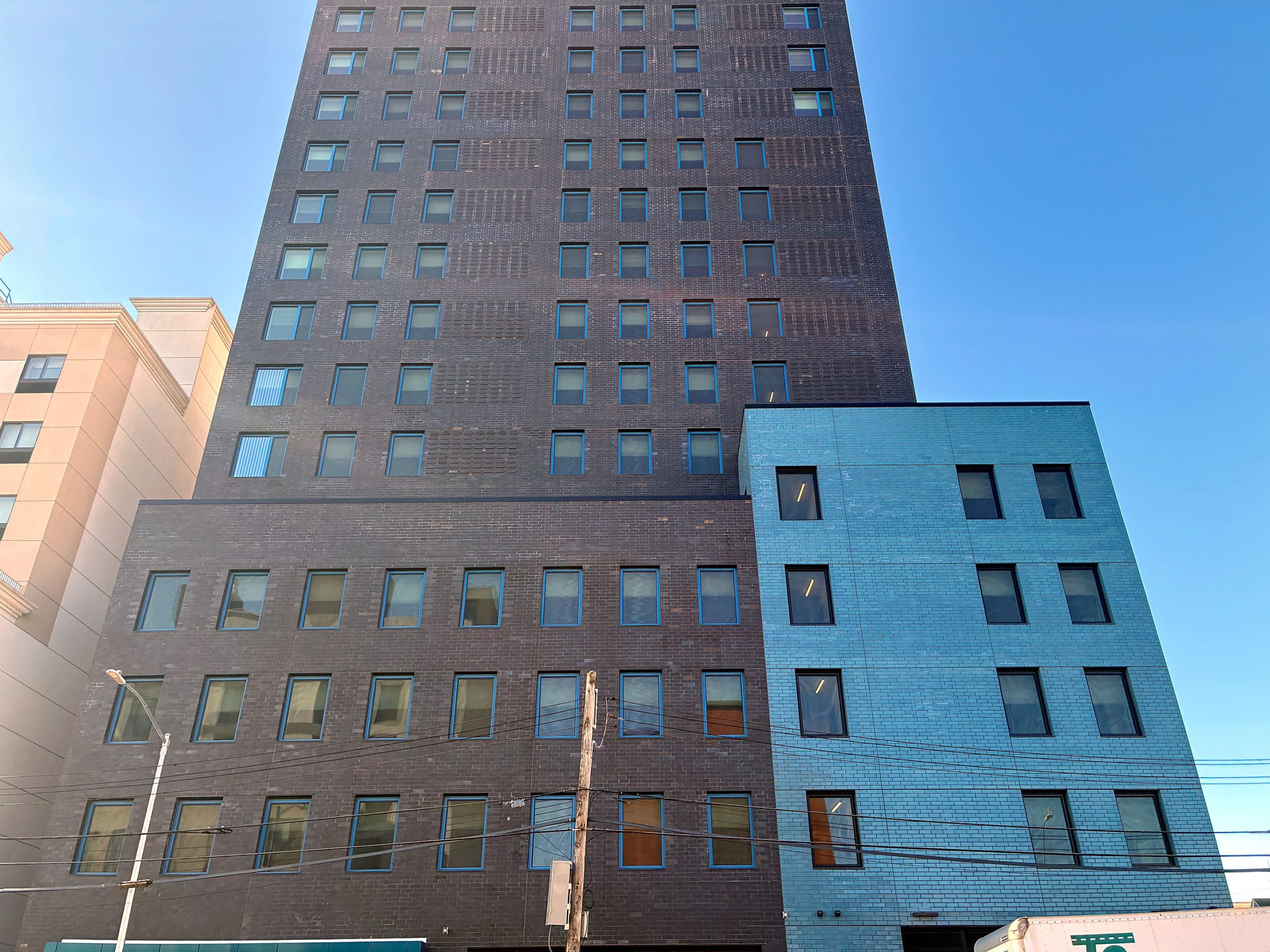
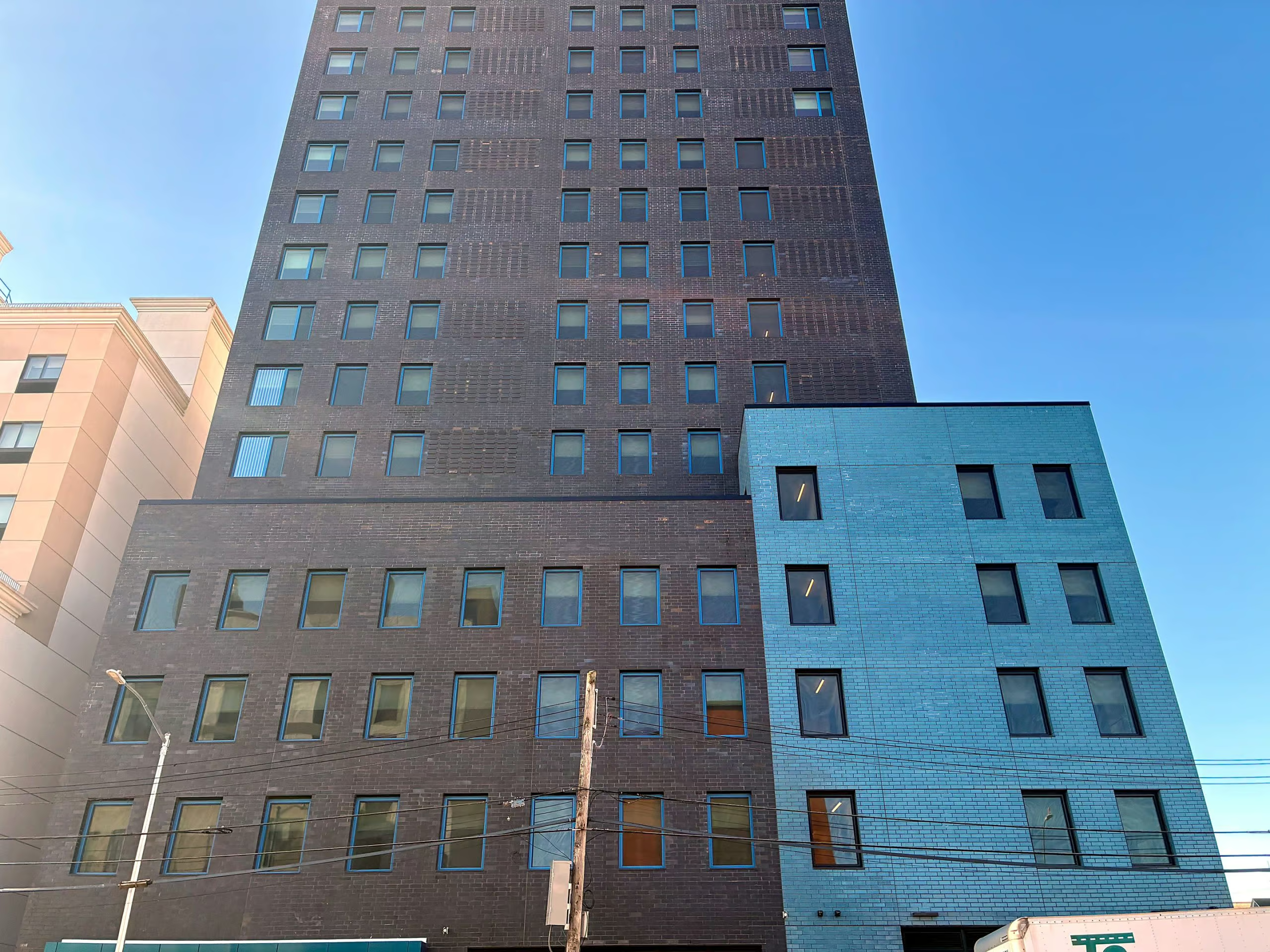
The Sutphin Senior Residence is a 15-story affordable housing project at 97–10 Sutphin Boulevard in Jamaica, Queens. It’s designed to Passive House standards.
The team specified 7,900 linear feet of GreenGirt XO in 4-inch depth. The goal was to align the thermal plane of every window with the thermal plane of the wall continuous insulation, so the envelope performs as one continuous assembly.
| Architect | Bernheimer Architecture |
|---|---|
| General Contractor | Monadnock Construction |
| Systems specified | GreenGirt XO™ |
| Project size | 7,900 LF |
| Performance target | Passive House |


Wayland, MI • Hospitality
Gun Lake Casino Hotel & Natatorium
The Gun Lake project is a multi-phase hospitality expansion. It includes a 15-story hotel, a full-service spa, meeting space, dining, and a natatorium with multiple swimming pools.
The envelope pairs 45,000 SF of GreenGirt CMH continuous insulation system on the walls with 2,200 SF of GreenGirt XO at some openings. 2.5-, 3-, and 4-inch depths at 16-inch on center, mineral wool insulation, ACM cladding over metal studs.
| Architect | HBG Design |
|---|---|
| General Contractor | Clark Construction Group |
| Installer | CEI Michigan, LLC |
| Systems specified | GreenGirt CMH™ + GreenGirt XO™ |
| Project size | 45,000 SF + 2,200 SF |
Frequently Asked Questions
What is structural thermal window framing?
Structural thermal window framing is a building envelope system that brings the window into alignment with the wall continuous insulation and eliminates the thermal bridging that would otherwise form at every window.
What is thermal flanking at windows, and why does it matter?
Thermal flanking is the heat-transfer path that bypasses wall continuous insulation by traveling through the metal head, jamb, and sill of a window opening. It matters because it can quietly negate a large share of the thermal performance the wall continuous insulation is supposed to deliver.
What is a structural thermal framing system for windows?
It’s a single element that carries continuous insulation across the rough opening, provides structural capacity for window and cladding loads, and is thermally broken so it doesn’t act as a metal bridge.
What Psi value should a window framing system achieve?
Lower is better. GreenGirt XO achieves a linear thermal transmittance (Psi, ψ) value of 0.025 BTU/(hr·ft·°F) [0.043 W/(m·K)] at sill, head, and jamb perimeter conditions, third-party verified per ISO 10211 by RDH Building Science. Based on basis-of-design simulation of steel-stud framing, exterior continuous insulation, and aluminum framed-fenestration. For Passive House and similar high-performance targets, junction-level Psi values are evaluated explicitly and need to be documented at the project level.
How does thermal window framing affect ASHRAE 90.1 compliance?
ASHRAE 90.1 sets minimum envelope performance and assumes the continuous insulation specified in the wall actually behaves as continuous insulation. Aligning the thermal plane of the window framing with the thermal plane of the wall continuous insulation is what closes the thermal flanking path at openings and lets the as-built envelope match the modeled performance. For more on ASHRAE 90.1 in commercial envelopes, read the related article.
Does thermal window framing work with CMU, stud, and precast walls?
Yes. GreenGirt XO is detailed for CMU, stud, and precast substrates, so the same family of systems works across the wall types most commonly used on commercial projects.
What’s the difference between a thermal break clip and a structural thermal framing system?
A thermal break clip addresses a single connection point. A structural thermal framing system addresses the full perimeter of the opening, including head, jamb, and sill, and also carries structural load.
How is window thermal performance tested and reported?
Linear thermal transmittance, the Psi value, is calculated per ISO 10211 and reported with third-party verification. A2P’s Psi data is verified by RDH Building Science.
What is window wall thermal performance, and how is it measured?
Window wall thermal performance is the thermal behavior of the entire window assembly in context, including the framing at the head, jamb, and sill. It’s typically measured by combining the U-factor of the window itself with the Psi value at the framing junctions, calculated per ISO 10211. A high-performing wall with a poorly framed window opening will underperform regardless of the wall’s R-value, which is why the framing system at the opening matters as much as the window unit.
Can structural thermal window framing be retrofitted, or is it only for new construction?
The systems are designed primarily for new construction and major envelope retrofits where the wall continuous insulation is being added or replaced. For project-specific retrofit applications, work with A2P engineering.
What is the GreenGirt XO system, and how does it relate to thermal window framing?
GreenGirt XO is A2P’s structural thermal framing system for windows and openings. It’s part of Advanced Architectural Products’ portfolio of building envelope systems and is engineered to be paired with GreenGirt CMH on the wall, GreenGirt CMH Roof™ at the roof, and SMARTci at the full enclosure.
Specify with A2P
If your wall continuous insulation has to perform the way you designed it, the wall is only part of the answer. The window opening has to keep up.
GreenGirt XO™ is part of Advanced Architectural Products’ portfolio of building envelope systems, alongside GreenGirt CMH™, GreenGirt CMH Roof™, GreenGirt Steel™, and SMARTci®.