








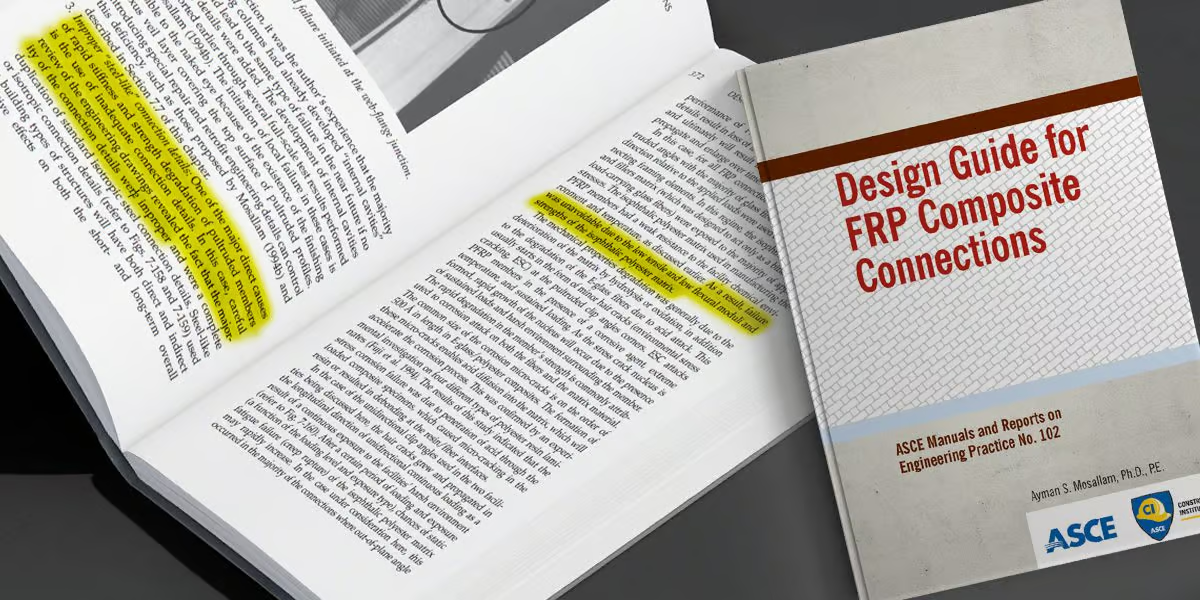
What is unavoidable fastener failure?
Unavoidable fastener failure is the progressive loosening and pull-out of screws anchored directly into fiber-reinforced polymer (FRP) sub-framing, a failure mode the American Society of Civil Engineers (ASCE) has documented at the connection level. Reviewing a failed pultruded FRP structure, the ASCE Design Guide for FRP Composite Connections concluded that because the connection details were improper, “failure was unavoidable” (page 371). The failure is not caused by a defective screw or a careless installer. It is built into the attachment system the moment a self-tapping screw is driven into a material that cannot permanently hold it.
That distinction matters for everyone who touches a building envelope. If fastener failure were a fastener problem, the fix would be a better screw. Because it is an attachment system problem, the fix is a better system: one where every fastener threads into steel, not into a fiber-and-resin matrix. That is the engineering principle behind GreenGirt CMH™, which consists of a composite metal hybrid material that combines thermal break performance with steel-grade structural capacity in one element, part of Advanced Architectural Products’ portfolio of building envelope systems.
Why do fasteners fail in continuous insulation systems?
Fasteners fail when the sub-framing material behind them cannot sustain the concentrated load, temperature swings, and load cycles of a building envelope. In FRP-only Z-girts, a screw thread severs the fibers that give the material its strength, concentrates the cladding load into a small interlaminar zone, and then degrades further as service temperatures climb toward 180°F. The screw is doing its job. The material around it is not.
Four mechanisms drive the failure, and all four are documented in A2P’s white paper on fastener failure in FRP versus permanent fastening in steel:
- Fiber damage at the hole. Screw threads are designed to bite into metal. In FRP they cut the load-carrying fibers instead. As Dr. Mahmood Haq, civil and structural engineering professor at Michigan State University, explains: “Drilling a hole in composites sacrifices up to 60 percent of the load carrying capacity. The minute you drill a hole, the fibers become discontinuous, you create stress concentrations around the hole, and you cause delamination, all of which act as failure initiation points” (Composites Manufacturing, July/August 2017).
- Force concentration. A cladding fastener on a typical 24-inch grid carries the wind load of roughly 4 square feet of wall, concentrated on the thread bearing area at a multiple of 8,000 to 30,000. A fastener with no external load at all can exert an interlaminar force of up to 4,641 psi on FRP, while the interlaminar capacity of many FRPs is only 2,000 to 6,000 psi.
- Elevated service temperature. The service temperature within many building envelopes often spans the range of -40°F to 180°F, and can exceed ambient air temperature by up to 90°F. At elevated temperatures, screw capacity in polyester and vinylester resins can diminish by more than 90 percent. Read more about maximum service temperatures of traditional building materials.
- Screw creep. FRP deforms progressively under sustained load, and every load cycle accumulates micro-damage around the threads. The result is the slow back-out and loosening that shows up years before the cladding does anything visible. See screw pull-out and screw creep rupture in FRP.
Construction is not the only industry wrestling with this. Dr. Haq’s research group at Michigan State University studies joining for industries where metal parts are increasingly replaced with composites, and treats composite-to-metal joining as its own unsolved engineering problem. “Joints are the weakest link,” Haq says. “If you can understand the joints well, then you can design the structure well.” Joining like to like, composites to composites or metal to metal, is relatively easy; joining metal to composites is where traditional methods break down (Flynn and O’Leary, “From Concepts to Composites,” Composites Manufacturing, July/August 2017). A cladding screw driven through an FRP-only Z-girt is exactly that joint, repeated thousands of times across a wall.
How long do fasteners stay attached in FRP-only Z-girts versus steel and GreenGirt CMH?
In A2P’s 2023 seven-day fastener pull-out test, based on ASTM D7332-B and run at 180°F, screws in generic FRP failed in as little as 59 seconds while carrying only 50 percent of ultimate pull-out load (435 pounds). Screws in 16-gauge steel and GreenGirt CMH carried 90 percent of ultimate pull-out load (552 pounds) at the same temperature for the full seven days without failing. In FRP-only Z-girts under extreme service temperatures, fastener attachment is measured in minutes and hours. In steel and GreenGirt CMH, it holds indefinitely.
The test conditions were chosen to match reality, not to flatter it. In warm-weather months, the cavity inside a wall assembly routinely runs far hotter than the air outside; building envelope temperatures can exceed ambient by up to 90°F, and 180°F sits at the top of the -40°F to 180°F service range the envelope is expected to survive. A pull-out value measured at room temperature describes a laboratory. This test describes a south-facing wall in July. The results:
- Generic FRP A: failed at 59 seconds at 180°F, at 50 percent of ultimate pull-out load (435 pounds).
- Generic FRP B: failed at 1 minute 24 seconds at a lower temperature of 158°F.
- Generic FRP C: lasted just over 2 hours under the same conditions as FRP A before failing.
- 16-gauge steel: no failure after seven days at 180°F at 90 percent of ultimate pull-out (552 pounds).
- GreenGirt CMH (with 16-gauge G-90 steel-reinforced flanges): no failure after seven days under the identical 90 percent, 180°F protocol.
Two materials ran at nearly double the load percentage for seven days without failing, and only the clock ended the test. Three FRP samples failed at half the load in seconds to hours, with failure times that varied even within the same batch. That scatter is itself a finding: single-sample or room-temperature data cannot qualify FRP for this application.
The evidence is public and citable. You can read the full test method, conditions, and data in A2P’s white paper on fastener failure in FRP versus permanent fastening in steel. Everything else in this article follows from what those seven days showed.
Is fastener failure inevitable in the system I specify?
No. Fastener failure is inevitable only when self-tapping screws are anchored directly into FRP-only sub-framing. When every fastener terminates in steel, whether in a steel Z-girt or in the steel-reinforced flanges of a composite metal hybrid system, the connection behaves the way the construction industry has assumed for decades: a self-drilling fastener in steel operating at 90 percent of capacity can last the lifetime of the building.
The liability question is direct. The ASCE Design Guide for FRP Composite Connections recognizes three joining schemes for pultruded FRP: bolted, adhesively bonded, and combined bolted-and-bonded (page 19). Self-tapping screws are not one of them. A specification that relies on screws in FRP-only Z-girts departs from the published guidance of the standards body most likely to be cited if the connection is ever questioned.
How do I specify an attachment system for a 50-year service life? Specify by the connection, not by the Z-girt. Three requirements close the gap:
- Metal-to-metal fastening. Require that cladding fasteners engage steel, either directly or through steel-reinforced flanges. This is the difference between a permanent connection and a short-term one. See how permanent FRP material connections use bolts and backer plates when no steel path exists.
- Verified pull-out data at service temperature. Require seven-day ASTM D7332-B pull-out testing at a minimum of 180°F, with at least ten samples. Room-temperature values do not describe a wall in August.
- An ASCE-recognized connection. Require that the connection detail match one of the schemes the ASCE Design Guide for FRP Composite Connections recognizes for FRP (bolted, bonded, or combined), or a metal-to-metal fastening path that removes the question entirely.
Which details should I avoid? Avoid any detail where a self-tapping screw is the permanent structural connection into FRP. Avoid butt joints of FRP Z-girts on single studs; ASCE edge-distance requirements make the math fail on a standard 1.5-inch stud face. And avoid cantilevered FRP Z-girt ends without a documented stress analysis; in A2P’s 2020 finite element study, the 23-inch cantilever cases drove generic FRP Z-girts into instability. Review Z-girt joinery methods for the comparison.
Why are screws backing out of the cladding support?
Screws back out of FRP-only sub-framing because the material relaxes around the threads over time, a process called screw creep. It is a material behavior, not an installation error. Each thermal cycle and load cycle loosens the grip a little more, so a wall that passed inspection at closeout can present loose fasteners a few seasons later.
What is the difference between over-torque and under-torque in FRP? Both shorten the life of the connection, for different reasons. Over-torquing preloads the fastener, which raises the interlaminar stress around the threads and accelerates creep damage. Under-torquing leaves the cladding able to move, so every gust cycles the connection. In steel there is a wide window between the two. In FRP the window is narrow and it closes as the material ages. This is also why impact drivers are not recommended on metal or composite materials; they make controlled torque nearly impossible.
How much embedment do I need? In FRP alone, more embedment buys less than expected, because pull-out strength is limited by the interlaminar shear capacity of the laminate rather than by thread count. The reliable fix is to change what the threads engage. In the GreenGirt CMH™ continuous insulation system, the self-drilling fastener passes through the cladding and the composite, then taps into the steel-reinforced flange. The threads bite steel first, and pull-out values match the system’s steel counterpart.
How many marginal fasteners does a wall really have? Field data puts defective or improperly installed self-drilling screws at 3 to 5 percent of any large installation. A 20,000-square-foot wall with fasteners at 16 by 24 inches on center holds roughly 7,518 fasteners, so a 4 percent defect rate leaves about 300 that are not working. Each one shifts its load to its neighbors, which can double their demand. Steel carries that margin. FRP under sustained load at temperature does not; the neighbors’ remaining life is measured in hours. See tributary area and load distribution on composite sub-framing.
Will fastener failure become a major capital expense?
It depends on what the fasteners are anchored into. Cladding attachment that terminates in steel is a decades-scale asset; the industry’s standard assumption is that a self-drilling fastener in steel at 90 percent of capacity lasts for decades. Cladding attachment that relies on screws in FRP-only sub-framing carries a documented risk of progressive loosening, re-fastening campaigns, and in the worst-case cascading cladding failure.
How long should the attachment system last? As long as the building envelope itself, holding rated capacity across the full -40°F to 180°F service range, not just at the room temperature where most catalog values are measured. Published creep research on FRP is sobering: specimens loaded to 30 percent of ultimate tensile strength at 77°F have failed in as little as 15 years, and fiberglass plastic pipe under sustained pressure retains only 35 to 40 percent of its ultimate strength at 11.5 years (ASCE LRFD Pre-Standard, 2010). Learn what service temperature means and why it matters.
What maintenance prevents fastener failure? With a metal-to-metal attachment system, fastener maintenance is essentially corrosion management, addressed by coatings such as the G-90 galvanization on GreenGirt CMH steel components. With FRP-only sub-framing, no inspection interval can restore the material around the threads, and re-torquing a crept connection adds preload and accelerates the damage. Material selection at specification time is the maintenance decision.
Is normal façade movement a warning sign? Building envelopes move; thermal expansion and contraction are engineered into good systems with details like interlocking joints that allow movement without loading the fasteners. Movement becomes a warning sign when it shows up as loosened fasteners, backed-out screw heads, or cladding panels that rattle. Those are connection symptoms, and on FRP-only sub-framing they warrant an engineering review rather than a re-screwing work order.
What do ASCE design guides say about fastening into FRP?
The ASCE Design Guide for FRP Composite Connections recognizes bolted, adhesively bonded, and combined connections as the schemes for pultruded FRP joints (page 19). Screws anchored directly into FRP are not a recognized permanent connection. In its analysis of a failed pultruded structure, the same guide concluded that with improper connection details, “failure was unavoidable” (page 371).
The full passage states: “One of the major direct causes of rapid stiffness and strength degradation of pultruded members is the use of inadequate connection details. In this case, careful review of the engineering drawings revealed the fact that the majority of the connection details were improper… As a result, failure was unavoidable.” ASCE connection practice for FRP, including backer plates, bolts, and washers to distribute load, has been codified for over 50 years. When girts carry the structure of a building enclosure, the connection detail is the design.
How do FRP-only, steel, and GreenGirt CMH sub-framing compare for fastener performance?
FRP-only Z-girts insulate well but cannot permanently hold a screw; steel girts hold screws for decades but conduct heat; the GreenGirt CMH system delivers both, holding fasteners in steel-reinforced flanges while the composite body maintains the thermal break.
| Category | GreenGirt CMH™ system | Generic FRP-only Z-girt | Steel Z-girt |
|---|---|---|---|
| Fastener engagement | Threads bite the steel-reinforced flange | Threads cut into fibers and resin | Threads bite steel |
| Seven-day pull-out at 180°F (2023, ASTM D7332-B basis) | No failure in 7 days at 90% load (552 pounds) | Failed in 59 seconds to ~2 hours at 50% load (435 pounds) | No failure in 7 days at 90% load (552 pounds) |
| Transverse tensile strength (ASTM D638) | 40,000 psi | 10,000 psi | Steel-grade |
| Screw capacity at elevated temperature | Stable within service range | Can diminish by more than 90% (polyester/vinylester resins) | Stable within service range |
| ASCE-recognized permanent screw connection | Yes; continuous steel fastening path is integral | No; bolts and backer plates required | Yes |
| Thermal bridging | Thermal break maintained by the composite body | Low conductivity | Conductive; thermal bridging risk |
| Girt-to-girt joinery | Interlocking joint that allows thermal movement | Cantilever or double-stud butt joints | Lap joints |
| How long fasteners stay attached under load at 180°F | Seven days without failure; decades-scale in service | Minutes to hours (59 seconds to ~2 hours in 2023 testing) | Seven days without failure; decades-scale in service |
What one question exposes an attachment system’s long-term risk?
Ask every sub-framing supplier: “Has this system passed a seven-day ASTM D7332-B fastener pull-out test at 180°F, and will you share the data?” A system that fastens into steel passes it. A system that relies on screws in FRP alone cannot, and the published failure times are measured in seconds and hours, not years.
If the answer is a room-temperature value from a catalog, that number describes a laboratory, not a building envelope in service. Request the temperature, the load percentage, the duration, and the sample count.
Which codes and standards govern fastener performance in composite sub-framing?
The governing references for fastener performance are the ASCE Design Guide for FRP Composite Connections, the ASCE Pre-Standard for Load and Resistance Factor Design of Pultruded FRP Structures (2010), ASTM D7332 Procedure B for fastener pull-through resistance, and ASTM D638 for tensile properties.
The practical note for specifiers: the standard that matters most for fastener durability is ASTM D7332 Procedure B run under load, at service temperature, over time. A pass at room temperature for a few seconds is not evidence of a connection that will hold through twenty summers. Review fastener retention best practices for the full engineering position.
Where does this hold up in the field?
The primary proof is the published, filmed seven-day fastener pull-out test: generic FRP failed at 50 percent load in as little as 59 seconds at 180°F, while 16-gauge steel and GreenGirt CMH completed seven days at 90 percent load without failure. The same fastening principle is in service across more than 4,000 completed projects using Advanced Architectural Products systems, including the three below.

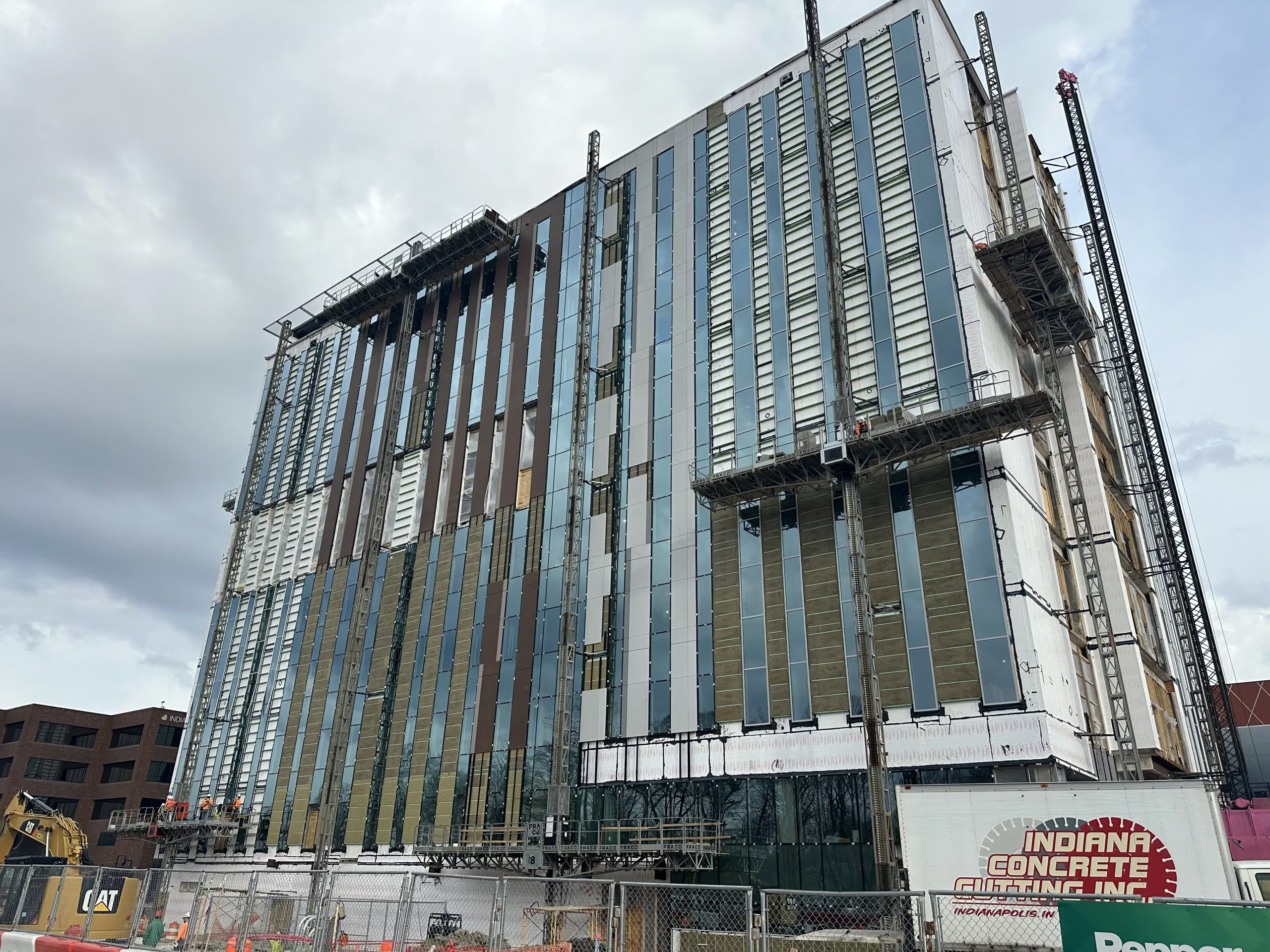
Indianapolis, IN • Health care
Peyton Manning Children’s Hospital at Ascension St. Vincent
Why it matters: This tower carries stone cladding, one of the heavier claddings an attachment system can be asked to hold, and the wall units were prefabricated off-site and transported for rapid installation. Every cladding fastener threads into the steel-reinforced flanges of the GreenGirt Max CMH system, so the connections that survived handling and transport are the same permanent, metal-to-metal connections now carrying the façade of a hospital that cannot afford a re-fastening campaign.
| Architect | Cannon Design |
|---|---|
| General Contractor | Pepper Construction |
| Installer | Engineered Façades |
| Systems specified | GreenGirt Max CMH™ (4-inch girts, horizontal and vertical, 24 inches on center) |

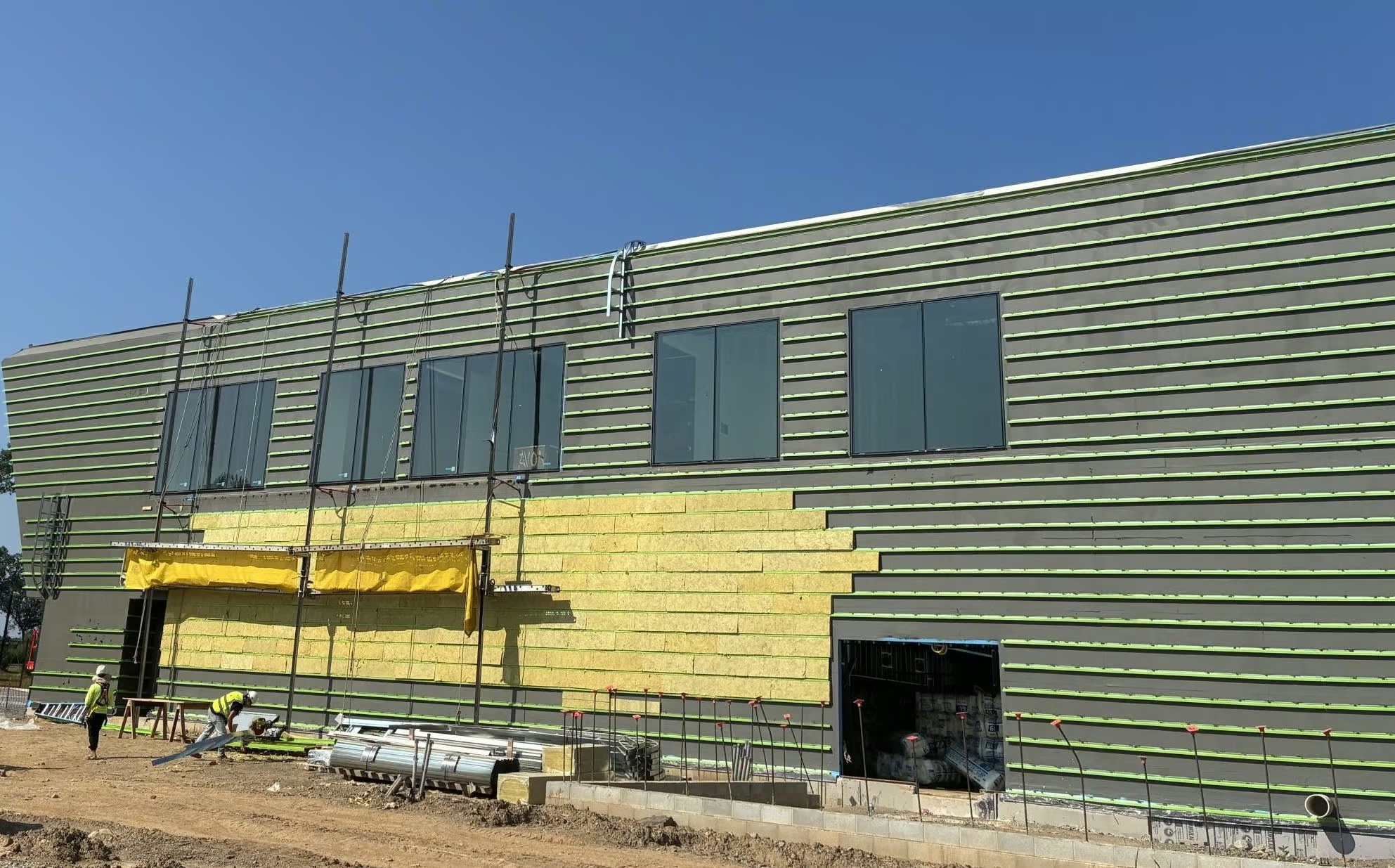
Morristown, NJ • Recreation
Red Bulls Arena Training Center
Why it matters: The girts here run at a wider 32-inch on-center spacing than a standard layout, which increases the tributary load every girt and every fastener must carry. That is exactly the condition where screw creep in FRP-only sub-framing accelerates. Because each fastener terminates in steel, the system accommodates the wider spacing while carrying the aluminum composite cladding on a thermally broken support.
| Architect | Gensler |
|---|---|
| General Contractor | March Associates |
| Installer | FM Construction Group |
| Systems specified | GreenGirt Max CMH™ (2.5-inch girts, horizontal, 32 inches on center) |

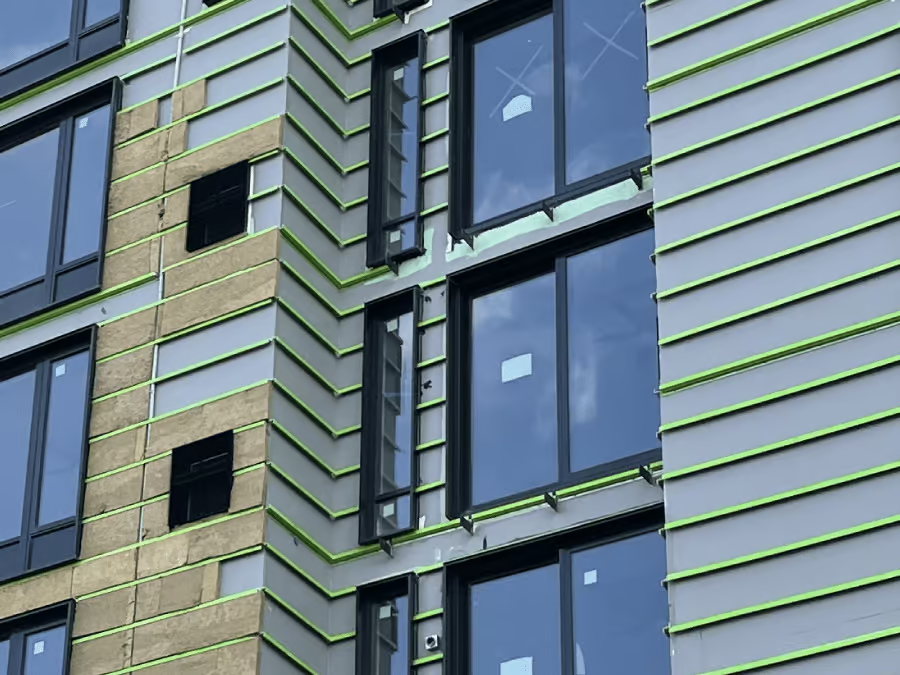
Denver, CO • MIXED USE RESIDENTIAL
26th and Alcott
Why it matters:A 15-story façade in Denver faces two stresses at once: wind loads that climb with height and the sharp day-to-night temperature swings of a high-altitude climate, the same load-and-release rhythm that loosens fasteners in FRP-only systems. Across 144,000 square feet of stucco and metal panels, every connection terminates in the steel-reinforced flanges of the GreenGirt Max CMH system, so the fasteners stay stable on upper floors where any re-fastening work would be slow and costly to reach.
| Architect | OZ Architecture |
|---|---|
| General Contractor | The Weitz Company |
| Installer | BigHorn Plastering |
| Systems specified | GreenGirt Max CMH™ (2-inch girts, horizontal, 16 inches on center) |
Frequently Asked Questions
Why do fasteners fail in continuous insulation systems?
Fasteners fail when they are anchored into sub-framing that cannot permanently hold them. In FRP-only Z-girts, screw threads sever load-carrying fibers, concentrate stress in weak interlaminar zones, and lose capacity as temperatures rise, so the connection degrades even when installation was perfect. Metal-to-metal connections do not share this failure mode. Learn more about screw pull-out and screw creep rupture in FRP.
Can you use self-tapping screws in FRP?
Not as a permanent structural connection. The ASCE Design Guide for FRP Composite Connections recognizes bolted, adhesively bonded, and combined connections for pultruded FRP; screws alone are not among them. Where generic FRP must be fastened, best practice calls for bolts, washers, and metal backer plates to distribute the load. See why permanent FRP connections need bolts and backer plates.
Why are screws backing out of my cladding?
Screw back-out on FRP-only sub-framing is usually screw creep: time-dependent relaxation of the composite around the threads under load and temperature cycling. It is a material behavior, not an installer error, and re-torquing accelerates it by adding preload. A review of Z-girt joinery methods shows how connection design determines long-term retention.
What temperature does a building envelope actually reach?
The service temperature within many building envelopes often spans the range of -40°F to 180°F, and envelope temperatures can exceed ambient air temperature by up to 90°F. Sub-framing and fasteners live inside that environment for the life of the building. Read about maximum service temperatures of traditional building materials.
How long can a screw hold in FRP under load?
In A2P’s testing at 180°F and 50 percent of ultimate pull-out load, generic FRP samples held a #14 fastener for between 59 seconds and roughly 2 hours before failing. Failure times varied drastically even within the same batch of material. See the impact of screw pull-out in construction.
What did the seven-day pull-out test prove about steel and GreenGirt CMH?
Both 16-gauge steel and GreenGirt CMH carried 90 percent of ultimate pull-out load (552 pounds) at 180°F for seven days of continuous testing without failure, at nearly double the load percentage that failed the FRP samples in seconds to hours. You can watch the seven-day fastener pull-out resistance test.
Is fastener failure the installer’s fault?
Usually not. Even a flawless installation cannot prevent creep, fiber damage, and temperature-driven capacity loss in FRP-only sub-framing, and typical projects already include 3 to 5 percent defective or improperly installed fasteners that shift load to their neighbors. Tool choice matters too; see why impact drivers are not recommended on metal or composite materials.
How much strength does drilling a hole remove from FRP?
Up to 60 percent of load-carrying capacity, according to Dr. Mahmood Haq of Michigan State University, because drilling makes fibers discontinuous, creates stress concentrations, and causes delamination that acts as failure initiation points. Compare materials in FRP versus steel: weighing efficiency and durability.
How long do fasteners stay attached in steel or GreenGirt CMH Z-girts?
Indefinitely, under normal service conditions. A self-drilling fastener in steel operating at 90 percent of capacity is expected to last for decades, and in A2P’s 2023 seven-day test at 180°F, neither 16-gauge steel nor GreenGirt CMH failed at 90 percent of ultimate pull-out load; only the clock ended the test. Review fastener retention best practices.
What attachment system lasts longest for cladding?
Systems in which every structural fastener terminates in steel. A self-drilling fastener in steel at 90 percent of capacity can last for decades, which is why the GreenGirt CMH system routes every cladding screw into steel-reinforced flanges while its composite body maintains the thermal break. Explore the GreenGirt CMH Clips system.
Does GreenGirt CMH require backer plates or special fasteners?
No. Standard self-drilling sheet metal screws are sufficient because the steel fastening path is built into the system; the design inherently follows the ASCE best practices of load distribution and stress redirection that generic FRP must add with separate backer plates and bolts. See the GreenGirt Max CMH system.
Does eliminating fasteners through insulation also help thermally?
Yes. Reducing through-insulation fastening removes both a mechanical weak point and a thermal bridge, which is why attachment design and thermal design should be evaluated together. Read about eliminating through-metal and through-insulation fastening in continuous insulation systems.
Specify with A2P
Fastener retention is a system decision made at specification time, not a hardware decision made at the jobsite. A2P’s engineering team supports architects, installers, and owners from detail development through field installation, so the attachment system that appears in the drawings is the one that performs on the wall.
- Compare GreenGirt CMH Clips, GreenGirt Optima CMH, and GreenGirt Steel continuous insulation systems to match the system to the project.
- Talk to engineering about your project’s attachment and thermal requirements.
GreenGirt CMH™ is part of Advanced Architectural Products’ portfolio of building envelope systems, alongside GreenGirt Steel™ and SMARTci® building enclosure systems.